



In a world where navigation, traffic, and weather are seamlessly layered onto digital maps, one critical environment has remained largely invisible, the indoors. Today, Waterloo-based Mappedin is looking to change that, announcing a $24.5 million Series B round to expand its indoor mapping platform from individual buildings to entire cities. The round was led by Edison Partners, with participation from Betatron Venture Group.
While GPS and real-time data have transformed how people move outdoors, indoor environments remain fragmented and largely unmapped. This gap is more than just an inconvenience, it has real-world consequences, especially in emergency situations where coordination and response times are critical.
Mappedin is positioning indoor mapping as the next foundational layer of digital infrastructure. The company has already mapped more than 10 billion square feet across 86 countries, supporting navigation for over 450 million visitors in venues ranging from airports to stadiums.
Yet, according to the company, less than one percent of global indoor space has been digitally mapped.
From Buildings to Cities
With this new funding, Mappedin is shifting its focus from mapping individual properties to scaling across entire urban environments. The move signals a broader ambition to make indoor mapping as ubiquitous and essential as outdoor navigation systems.
“Today, Mappedin announced $24.5M in Series B funding, led by Edison Partners with participation from Betatron Venture Group,” said Hongwei Liu, Founder and CEO of Mappedin.
“When we started Mappedin, the idea was simple: the indoors should be as navigable as the outdoors. Since then, we’ve mapped over 10 billion square feet across 86 countries and guided 450 million visitors through some of the world’s largest properties, including Simon Property Group, LAX, and Super Bowl stadiums. This funding takes us from mapping individual buildings to entire cities.”
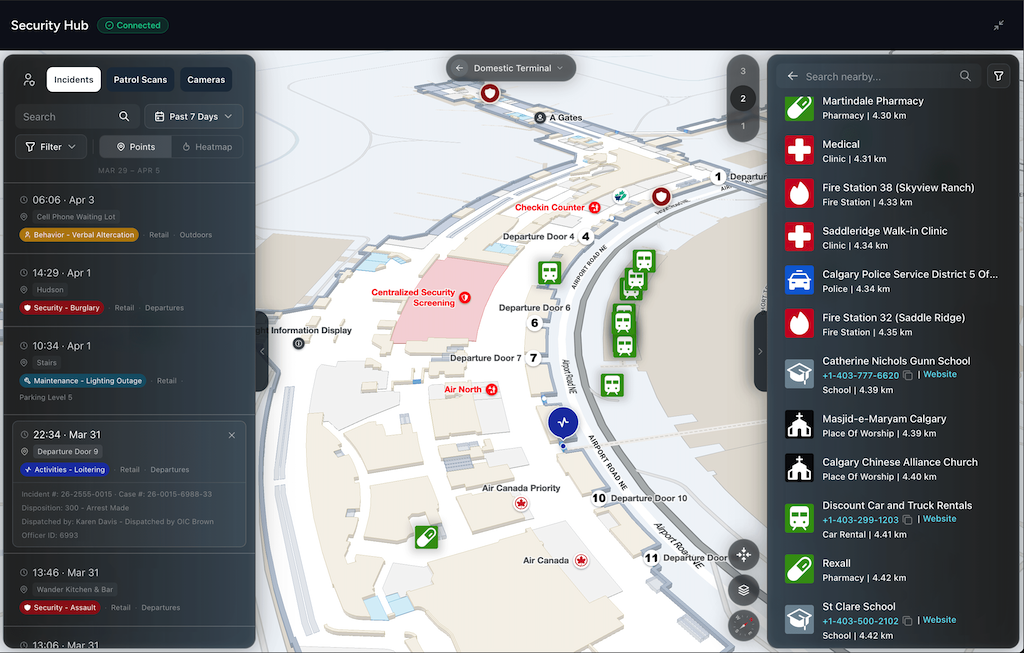
Mappedin Platform
Opening the Platform to Safety and Operations
Beyond navigation, Mappedin is expanding into safety and operations. By opening its platform to safety organizations and third-party developers, the company aims to enable new applications built on top of indoor spatial data.
This includes tools for emergency responders, building operators, and security teams who often rely on disconnected systems to manage complex environments like hospitals, campuses, and office towers.
“Indoor spaces are where people spend 90% of their time, but they’re still largely invisible to the systems meant to manage and protect them,” Liu added. “We’re changing that by giving safety officials, building operators, and their partners real tools to oversee and secure indoor environments at scale.”
The scale of the opportunity remains massive. With the vast majority of indoor spaces still unmapped, Mappedin is betting that its technology can become the backbone for a new category of infrastructure, one that brings visibility, coordination, and intelligence to the built environment.
“At this scale, indoor maps become infrastructure and we want to build it for every city on earth,” said Liu.
As digital and physical worlds continue to converge, Mappedin’s latest raise underscores a growing recognition that the next frontier of mapping is not outside, but inside.
