



Enterprise AI vendors have spent the past two years racing to simplify how organizations build intelligent applications. But for many companies, the harder problem has not been building models, it has been getting them into production. Corvic AI is betting that the next phase of the market will be defined less by model capability and more by infrastructure and deployment.
The Mountain View-based company announced this week that its platform is now fully transactable via AWS Marketplace, allowing enterprise customers to procure and deploy Corvic within their existing AWS environments. The move also expands access to the company’s latest platform release, V3, which is designed to address a persistent issue in enterprise AI systems: the complexity of data pipelines.
At a glance, the announcement may appear to be another marketplace listing in a growing ecosystem of AI tools. But the company is positioning the move as a step toward reducing friction in enterprise adoption, particularly the gap between initial evaluation and production deployment.
“Marketplace availability changes how quickly teams can move,” said Farshid Sabet, CEO and co-founder of Corvic AI. “Instead of navigating lengthy procurement and integration processes, customers can access the platform through systems they already trust, while maintaining full control over their data and environments.”
The Deployment Problem in Enterprise AI
While large language models have improved rapidly, many organizations continue to struggle with the systems surrounding them. AI projects often rely on layered architectures that include data pipelines, vector databases, retrieval systems, and orchestration frameworks. These components must be stitched together and maintained as underlying data evolves.
In practice, that approach can lead to systems that are difficult to scale and expensive to operate.
Corvic’s platform is built around a different model. Instead of requiring teams to normalize data into a single structure or maintain multiple pipelines, the company’s “Intelligence Composition Platform” is designed to operate directly across multi structured data, including documents, tables, logs, and images.
The V3 release extends that approach by improving performance and expanding accessibility, with the goal of making production grade AI systems easier to build and maintain.
The company’s argument is that the industry’s current focus on improving individual components, such as retrieval methods or orchestration tools, may be addressing symptoms rather than the underlying problem.
Marketplace as a GTM Shift
The AWS Marketplace listing reflects a broader trend among enterprise software vendors, where distribution and procurement are becoming as important as technical capability.
For customers, purchasing through AWS Marketplace can simplify vendor onboarding, consolidate spending into existing cloud budgets, and reduce the time required to move from pilot to deployment. Enterprise buyers also gain access to flexible commercial structures, such as private offers, which can streamline negotiations.
For Corvic, the listing serves as both a distribution channel and a signal of enterprise readiness. Meeting AWS Marketplace requirements typically involves demonstrating security, compliance, and operational maturity, areas that have become increasingly important as AI systems move into production environments.
Many of Corvic’s existing customers already operate within AWS, making the marketplace listing a logical extension of how those organizations evaluate and deploy new technology.
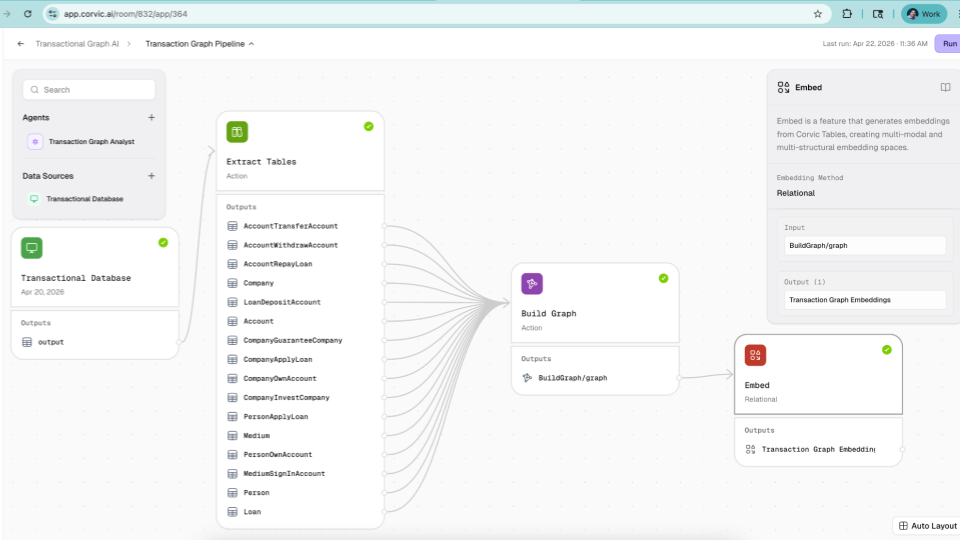
Corvic AI Platform
A Focus on Infrastructure, Not Models
The company’s messaging aligns with a growing shift in the enterprise AI conversation. As more organizations move beyond experimentation, attention is turning toward reliability, reproducibility, and operational overhead.
Corvic’s approach emphasizes infrastructure rather than model development. By focusing on how data is ingested, retrieved, and used in decision-making systems, the company is positioning itself as part of a new layer in the AI stack, one that sits between raw data and application logic.
This positioning reflects a broader recognition that the success of AI systems depends as much on the surrounding infrastructure as it does on the models themselves.
Balancing Adoption and Change
The challenge for companies like Corvic is convincing enterprises to rethink how those systems are built. Many organizations are deeply invested in existing architectures, even if they are inefficient or difficult to maintain.
Marketplace availability may help lower the barrier to entry by making it easier for teams to test alternative approaches without committing to large scale infrastructure changes upfront.
At the same time, the company’s success will depend on whether its model can deliver measurable improvements in production environments, where performance, accuracy, and reliability are critical.
What Comes Next
As enterprise AI matures, infrastructure decisions are becoming more consequential. The conversation is shifting away from what models can do in isolation to what systems can sustain in real world conditions.
Corvic’s AWS Marketplace launch is a relatively small step in that larger transition, but it points to where the company believes the market is heading: toward simpler deployment, reduced operational complexity, and systems designed to handle the messy reality of enterprise data.
Whether that approach gains traction will depend less on messaging and more on how well it performs in practice. But as companies continue to grapple with the challenges of production AI, the demand for alternatives to pipeline heavy architectures is likely to grow.
