


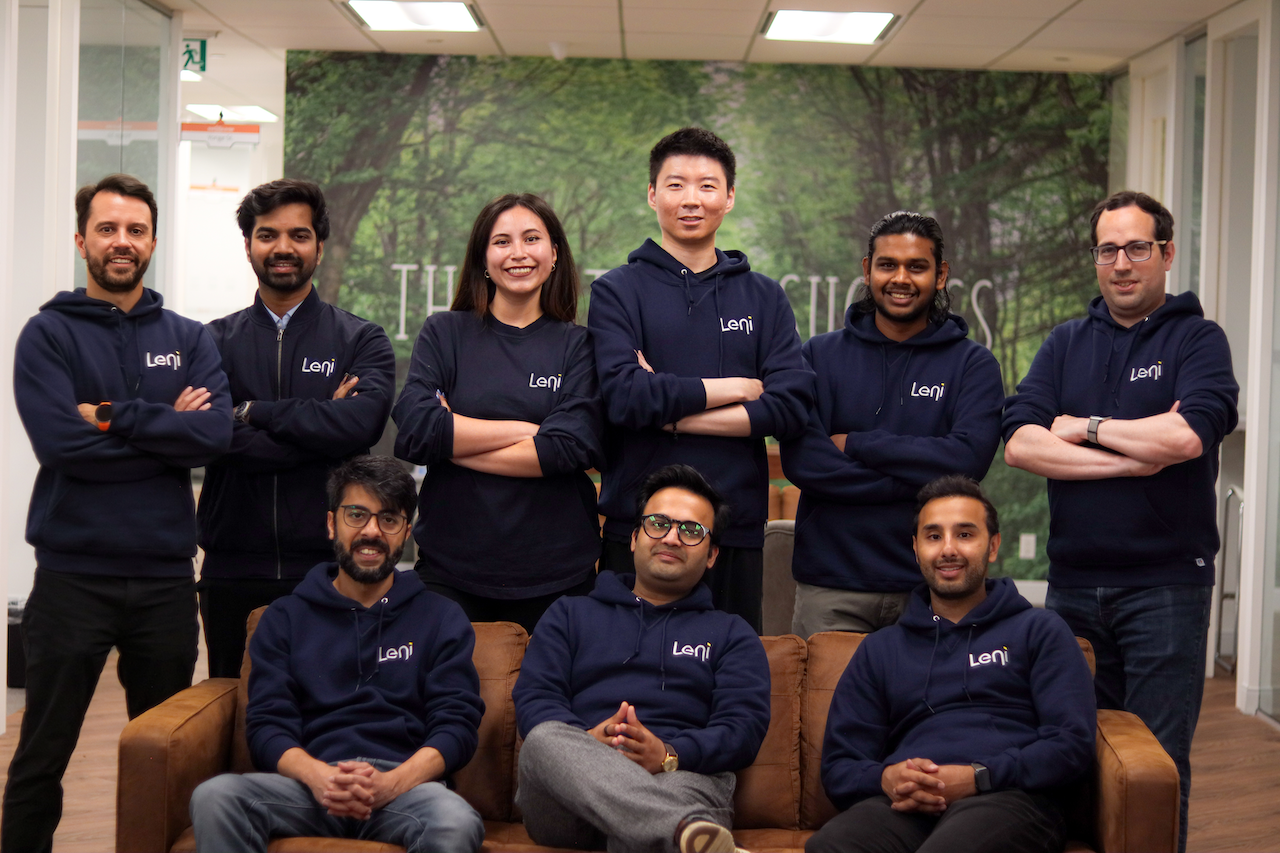
Leni is launching what it describes as the “World’s Most Accurate AI for Investors,” as the startup expands beyond its original commercial real estate focus into broader finance and business applications.
Founded by Arunabh Dastidar, Gaurav Madani, and Zain Nathoo, the company initially built its technology around commercial real estate workflows, helping investment teams manage underwriting, research, and reporting tasks. But as the platform evolved, Leni says its infrastructure became capable of supporting investment and operational workflows across additional financial and business sectors, marking a significant strategic pivot for the company.
The launch positions Leni as an enterprise-grade AI platform designed to automate and streamline complex investment workflows, with a particular emphasis on accuracy, verification, and repeatability.
The company says its platform is designed not merely to generate AI-powered answers, but to produce complete, usable work products for investment teams, including underwriting models, investment committee memos, market research reports, recurring portfolio reporting, and investor presentation materials.
The launch comes as investment firms continue experimenting with generative AI tools, while also grappling with concerns around hallucinations, unreliable outputs, and the difficulty of integrating AI into highly regulated, detail-sensitive financial workflows.
Leni has raised more than $8.5 million to build its platform and accelerate AI adoption within the investment industry.
“Accuracy and repeatability are the bar for serious investment workflows,” said Arunabh Dastidar, co-founder and CEO of Leni. “Our focus is making AI outputs verifiable: grounded in your documents, linked to sources, and packaged in the formats teams already use.”

Unlike consumer-facing AI chatbots, Leni is targeting institutional workflows where outputs often need to be audited, validated, and distributed across teams. The platform uses a multi-agent architecture that combines planning systems, task-specific execution agents, model routing, and grounded retrieval across documents, integrations, and web research.
According to the company, the system is built to help eliminate a range of repetitive manual processes that continue to consume time inside investment organizations. Those include reading and extracting information from lengthy documents, transferring data between underwriting spreadsheets and presentations, conducting fragmented market research, and assembling recurring reports from multiple internal systems.
The company says the platform can generate underwriting workbooks complete with formulas and sensitivity analyses, source-linked market research, investment committee memos, and recurring operational reporting once connected to enterprise systems.
Leni’s launch reflects a broader trend unfolding across financial services and commercial real estate, where startups and established software providers alike are racing to develop domain-specific AI systems tailored for industries where precision matters more than conversational fluency.
While many generative AI products have focused on productivity gains through summarization or chat interfaces, enterprise investment firms have increasingly demanded systems capable of producing verifiable outputs that integrate directly into existing workflows.
That demand has fueled a growing market for vertical AI platforms, particularly in industries where professionals spend large portions of their day navigating spreadsheets, legal documents, financial models, and fragmented data environments.
By centering its pitch on “finished work products” rather than AI-generated responses alone, Leni appears to be betting that enterprise adoption in finance will depend less on novelty and more on trust, auditability, and operational accuracy.
