


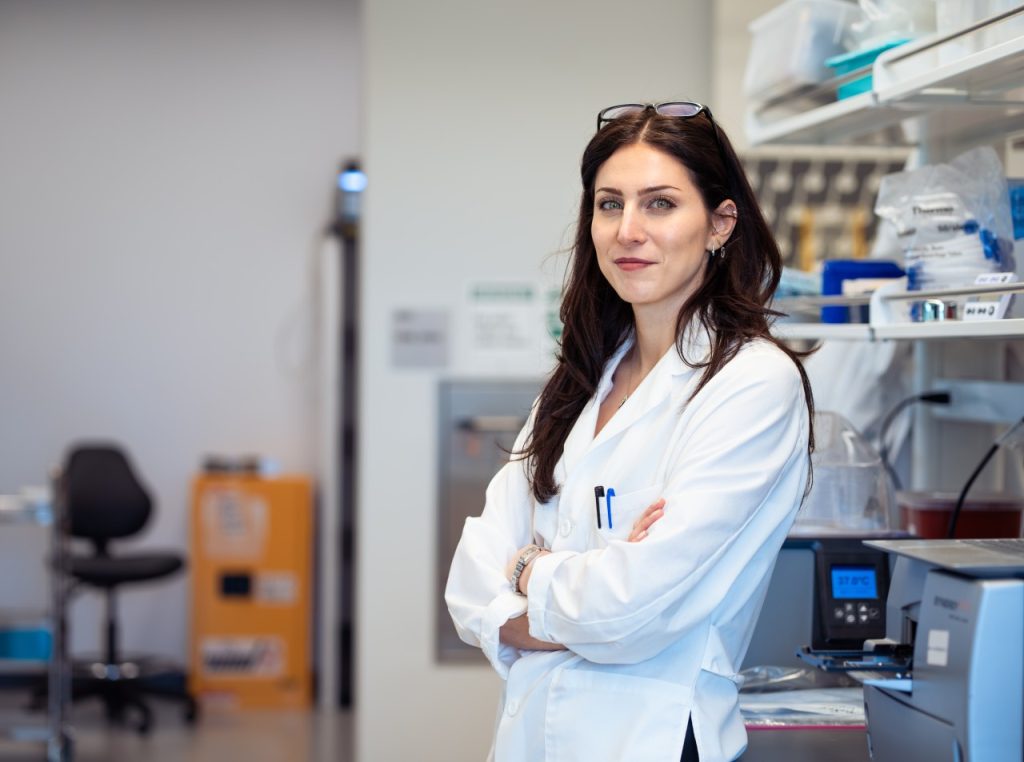
Most breakthroughs in cancer diagnostics focus on what happens after a sample reaches the lab. Rachelle Turiello believes the industry’s biggest opportunity may lie in what happens before.
As co-founder and CEO of Avant Genomics, Turiello is developing technology designed to solve one of the least visible but most consequential challenges in precision medicine: extracting and preserving enough DNA from blood samples to generate accurate results.
The company’s platform, Avant Source™, automates liquid biopsy sample preparation, a labor-intensive process that can determine whether clinicians detect cancer-related biomarkers or miss them entirely.
A Foundation in Forensics
Long before founding Avant Genomics, Turiello worked in forensic human identification and crime scene investigation, including roles supporting law enforcement in Maryland.
The work often involved analyzing highly degraded or contaminated DNA samples, where recovering even small amounts of genetic material could make the difference between success and failure.
“One of the things that stood out to me was that we were often working with very low-level contaminated DNA,” she says. “That was always top of mind for me.”
She also observed another challenge: even when promising new technologies emerged, they were often difficult for laboratories to adopt.
That realization led her to leave what she describes as a “very safe job” in public service and pursue a Ph.D. at the University of Virginia under Professor James Landers, a pioneer in microfluidic technologies.
There, she began developing tools aimed at improving DNA recovery from challenging samples.
An Unexpected Discovery
The technology that eventually became Avant Genomics wasn’t originally intended for cancer diagnostics.
Turiello and her co-founder, Renna Nouwairi, were developing methods to improve forensic sample processing when they attended a scientific conference in Croatia focused on both forensic science and precision medicine.
After presenting their work, researchers working in liquid biopsy and cancer detection approached them with an unexpected question. Could this technology improve cancer diagnostics?
“We hadn’t really considered it,” Turiello says. “We were not diagnostics folks. We were certainly not in precision oncology.”
Curious, the team returned to Virginia and partnered with researchers at the University of Virginia Cancer Center to test the technology on colorectal cancer samples The results exceeded expectations.
“It worked shockingly well,” she says.
The team secured grant funding, launched Avant Genomics, and began adapting the platform for liquid biopsy workflows. Today, the company is focused on helping laboratories recover more of the critical genetic material needed for cancer detection and monitoring.
Solving a Hidden Bottleneck
Liquid biopsies have emerged as one of the most promising areas in oncology. Rather than relying on invasive tissue biopsies, clinicians can analyze blood samples for circulating tumor DNA and other biomarkers. But according to Turiello, the sample preparation process remains a major limitation. Technicians can spend hours manually processing samples through dozens of pipetting and washing steps before any downstream testing begins. During that process, significant amounts of DNA can be lost.
“When you’re looking for circulating tumor DNA, there’s often a very small amount present,” she explains. “You can lose most of it during that first process. It can be the difference between a true positive and a false negative.”
Avant’s solution combines expertise in microfluidics, chemistry, and workflow design to improve DNA recovery while simplifying the process.
Rather than relying on a single breakthrough, Turiello says the improvement comes from optimizing numerous small variables.
“Everyone thinks there’s this magic bullet,” she says. “It’s really paying attention to all of the details.”
Scaling for Commercialization
Following an oversubscribed funding round, Avant Genomics is now focused on manufacturing scale-up and commercial deployment. The company is transitioning from low-volume production to a manufacturing process capable of producing hundreds of thousands of consumable cartridges annually.
At the same time, Avant is launching an early access program with laboratories and organizations across the healthcare ecosystem to validate performance in real-world settings. The company has also assembled a growing team that includes veterans from organizations such as Haystack Oncology, PGDx, and other leaders in precision medicine.
For Turiello, however, the mission extends beyond building a successful company. It’s about helping ensure that the next generation of blood-based diagnostics can deliver more reliable answers for physicians and patients alike.
“With better DNA in, you’ll get better results out,” she says.
As liquid biopsy continues to reshape cancer detection, treatment selection, and disease monitoring, Avant Genomics is betting that one of the biggest breakthroughs won’t come from a new test, but from improving the quality of the biological information that powers every test that follows.
