


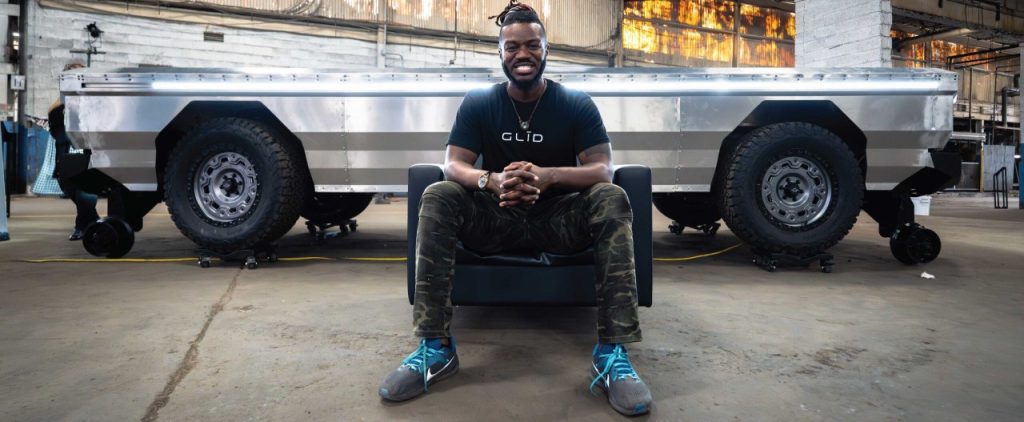
For decades, the logistics industry has chased efficiency at the edges of the supply chain. Companies have optimized warehouse automation, digitized inventory systems, and transformed last-mile delivery into a technological arms race. Yet believes the industry’s biggest opportunity has remained largely untouched.
“The first mile is where everything begins,” he says. “If you solve it there, you’re walking into the same line as your last mile, and everybody’s happier for it.”
As founder and CEO of Glīd Technologies, Damoa is building autonomous road-to-rail vehicles designed to eliminate one of freight transportation’s oldest bottlenecks: moving cargo between trucks and trains. The company’s vision extends beyond autonomous vehicles. It is an effort to modernize infrastructure that has changed remarkably little over generations, replacing labor-intensive transfers with intelligent, automated systems that synchronize road and rail.
For Damoa, the idea did not emerge from a brainstorming session or market report. It was the product of twenty-five years spent moving some of the world’s largest and most valuable assets.
His career began in military logistics, transporting tanks and heavy equipment across complex transportation networks. Later, at SpaceX, he managed logistics surrounding rockets and aerospace hardware where precision and planning were paramount. Despite the vastly different missions, he noticed an unmistakable pattern.
“It showed me how slow and cumbersome and dangerous and expensive it was,” Damoa says. “Later in my career I realized it wasn’t just one industry. It was every single industry that wanted to move goods across ground-based corridors.”
Rather than viewing freight through the lens of trucking or rail alone, Damoa saw a larger systems problem. Rail remains one of the most efficient methods of moving freight over long distances, yet much of its potential remains underutilized because connecting cargo to rail infrastructure is often costly, manual, and operationally complex.
“I felt like God gave me all the tools I needed to fix this,” he says. “Just looking at the numbers and seeing rail continue to degrade in utilization, I realized the easiest point to solve was accessibility. From an engineering perspective, from an operator perspective, and from helping communities that live adjacent to ports and railroads, it became clear this was the problem worth solving.”
Changing entrenched infrastructure, however, is far easier said than done.
Road and rail have operated as separate ecosystems for generations, supported by decades of regulations, labor agreements, and established operational practices. According to Damoa, the industry’s greatest obstacle is not technology but inertia.
“People say, ‘This is the way it’s always been, and it’s always going to be,'” he explains. “They’ll tell you unions won’t allow it or that operators won’t change. But somebody has to show what’s possible. That’s our responsibility as innovators.”
Building vehicles capable of seamlessly transitioning between highways and railways presents its own engineering challenges.
Unlike conventional trucks, Glīd’s platforms must perform in dramatically different physical environments. Rubber tires absorb road imperfections, while steel wheels traveling on steel rails transmit significantly greater forces into both the vehicle and its cargo.
“On the road, the suspension attenuates everything,” Damoa explains. “On the rail line, everything is metal to metal. You’re sending massive loads into your cargo and suspension systems. Finding that balance while also integrating electrification and autonomy is really the trick.”
That engineering philosophy has shaped Glīd’s flagship autonomous platform, Rāden.
Rather than designing another autonomous truck, Glīd reimagined the vehicle around freight itself. Removing the driver’s cab not only simplifies manufacturing and regulatory requirements, but also allows more space for payload while enabling a single remote operator to supervise multiple autonomous vehicles simultaneously.
“You remove the person from the vehicle and place that person into a human-in-the-loop environment,” Damoa says. “Instead of one person operating one truck, now one person can monitor seven to ten vehicles. At the same time, because you don’t have a cab, that space becomes usable cargo capacity. It changes the economics completely.”
The design also accelerates commercialization. Without the complexities associated with fully homologated passenger vehicles, Glīd can focus development on chassis, drivetrain, and powertrain systems while shortening time to market.
Still, introducing new infrastructure into one of the world’s most established industries requires more than technological innovation. It requires trust.
Damoa believes his background provides a unique advantage when speaking with customers because he has spent decades working alongside the very operators he hopes will adopt Glīd’s technology.
“I’ve been a logistician my entire career,” he says. “When I sit down with operators, we speak the same language. We ask about their pain points, intentionally affirm them, and then show them what could be.”
Rather than positioning Glīd as a replacement for trucks or railroads, Damoa views the company as filling a critical gap between them.
“We always say, ‘Don’t ship it. Just Glīd it,'” he says. “Road has its purpose. Rail has its purpose. Transfer facilities have their purpose. We fit into the niche where it matters most, those short-distance movements that connect everything together.”
That vision is now beginning to move beyond prototypes.
Over the coming months, Glīd plans to launch two pilot programs simultaneously, one with a railroad partner and another with the U.S. Army, demonstrating the company’s ability to serve both commercial and defense applications. At the same time, the company expects to pursue a financing round while selecting the site for its next manufacturing facility to support production scaling.
The military partnership is particularly meaningful for Damoa because many of Glīd’s design principles originated from his own experience in uniform.
“Everything came from military logistics,” he says. “We wanted to build something robust enough to handle military operations every day and then bring that same durability into the commercial market.”
Like many first-time founders, Damoa says the greatest challenge has not been inventing new technology but learning to build an organization around it.
“Inventing a product is easy when you’ve done it your whole life,” he says. “Being the CEO of a venture-backed company is another thing entirely. Raising capital, hitting your metrics, recruiting the right people, and maintaining culture, that’s the hard part.”
Today, as artificial intelligence rapidly transforms physical industries, Damoa believes logistics is approaching its own inflection point. While software has optimized supply chains for years, he argues the next leap forward will come from combining intelligent automation with physical infrastructure itself.
For Glīd, that means synchronizing road and rail through what Damoa describes as “physical AI,” modernizing legacy transportation systems while strengthening both commercial supply chains and national security.
If successful, the company’s impact may extend well beyond freight economics. It could reshape how goods move through ports, industrial parks, military installations, and transportation corridors around the world, proving that one of the oldest problems in logistics still has room
