

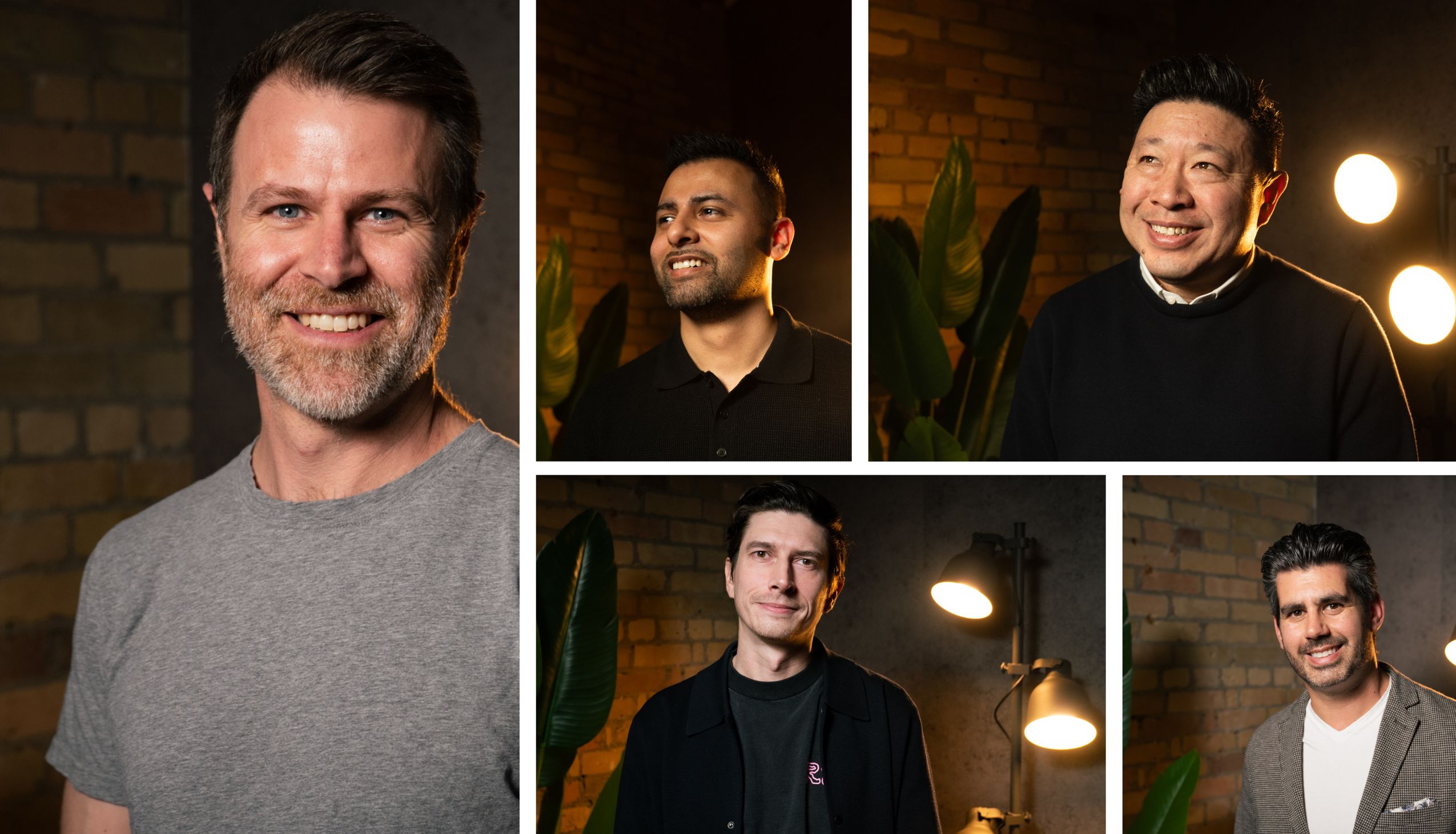
Photo Credit: Javon Martin / Clarity Content
As execution becomes faster and cheaper, founders are discovering that judgment, customer proximity, trust and human perspective matter more, not less.
Artificial intelligence is changing how quickly companies can build products, create content, run campaigns and complete the repetitive work that once occupied entire teams. That creates an obvious opportunity for founders: move faster, operate leaner and test more ideas.
It also creates a more difficult question.
When every company has access to similar tools, what still makes one business meaningfully different from another?
Five founders and business leaders with various backgrounds offered consistent answers, as they sat down in the studio with Daniel Francavilla for Moment of Clarity, an original series by Toronto-based Clarity Content. The series features short conversations with leaders about the realization, pivot or defining moment that changed how they approached their career, company or leadership.
Their companies operate across behavioural science, search, real estate technology, digital design, marketing and live experiences. Their stories are different, but they share one underlying belief:
Technology can accelerate the work, but it cannot decide what is worth building, understand a customer deeply, earn trust or bring conviction to a difficult decision.
Those responsibilities still belong to people.
When execution becomes automated, perspective becomes the advantage
Ben Wise is the co-founder of Captivate, a content, speaking and training platform that translates research on psychology and behavioural science into practical lessons about persuasion, storytelling and communication. He is also Head of Programmatic Media at Google. Captivate began as a monthly newsletter and has grown into a platform that helps professionals apply the science of influence in their work.
Wise sees a common mistake in B2B communication: companies assume that business buyers make entirely rational decisions. They fill presentations with features, proof points, specifications and logical arguments. Those details matter, but Wise argues that they are rarely sufficient on their own.
“The person on the other side of the desk or the other side of the video call is another human being.”
Stories can lower the instinctive resistance people feel when they sense they are being persuaded. They create space for an emotional connection before the buyer begins rationally evaluating the decision.
The same principle applies to AI-generated content. Wise is not against automation; he uses AI throughout his own process. His concern is what happens when companies outsource the source of the idea, rather than using technology to develop and distribute it.
“Make sure you are keeping that human voice, that human spark.”
As companies automate similar workflows using similar models, their output risks converging into what Wise calls a “sea of sameness.” The competitive advantage moves upstream—from producing the asset to developing the insight, understanding the audience and deciding what is worth saying.
Start with the problem, not the AI product
Mitch Parker is a 17-year real estate broker turned AI founder. He founded BrokerNest AI, which develops voice and communication infrastructure for real estate teams, and Stak72 AI, an AI consultancy for brokerages and operators. His experience inside real estate shaped the problems his companies now attempt to solve. (Mitch Parker Group)
Parker believes the accessibility of AI has created a predictable founder trap: people can now build products so quickly that they begin with the tool instead of the need.
“Don’t start with the product that you think is a really good idea.”
A technically functional product is not necessarily a valuable one. Parker’s advantage did not come from discovering a model unavailable to other founders. It came from spending years inside an industry and understanding where work repeatedly breaks down.
The next step is not prolonged development in isolation. Parker recommends building a basic minimum viable product and bringing it to people who understand the problem firsthand.
“The best thing to do is speak to people in that industry.”
That does not mean showing the product only to friends, family or supportive peers. Founders need feedback from operators who face the problem at scale and have little incentive to protect the founder’s feelings.
Parker’s broader lesson is that AI makes it possible to fail faster—but only founders who are willing to listen can turn that speed into progress. Falling in love with the solution before validating the problem simply allows a company to travel in the wrong direction more efficiently.
Create before you feel ready, but solve something real
Ali Abbas is an SEO and answer-engine optimization strategist and the founder of The SEO Button, a Toronto consultancy that helps companies grow through search and organic strategy.
Early in his career, Abbas noticed that organic search was driving significant traffic while many marketers remained focused on social media and email. He also saw a gap in the available SEO education: much of it was useful, but little of it was engaging enough for people to finish.
With only a few years of practical experience, he decided to create the kind of course he wished existed. The project took far longer than expected and required him to record it again, but it ultimately helped establish his credibility, supported his career and contributed to the creation of his consultancy.
The lesson is sometimes summarized as “create before you feel ready.” Abbas adds an important qualification: action works when it addresses a need.
“It did well in the marketplace because I was solving my own problem and I knew it existed.”
He describes the opportunity as an intersection between ability and demand:
“This is your skill set. This is what the market wants. You have to combine it.”
Building solely around market demand can produce work the founder has little interest in sustaining. Building solely around personal interest can produce something nobody wants. The more durable opportunity sits between the two.
Abbas’s story also challenges the idea that authority must always come before publishing. Useful work can create authority—but usefulness depends on recognizing a real gap, doing the difficult work and resisting shortcuts.
Efficiency can remove what clients valued in the first place
Symon Oliver is the founder and Design Director of Tennis, a Toronto web and product design agency. Tennis works across websites, digital products and member platforms, treating user experience, technology and operations as interconnected business problems.
For many agency owners, operational maturity is the goal. Better processes promise stronger margins, predictable delivery and fewer demands on the founder.
But there is a point at which optimization begins to work against the business. Oliver realized that Tennis had created too much distance between clients and the people doing the work. Project management processes had become efficient, but clients wanted closer collaboration with the production team. Team members wanted the same thing.
“It just felt like an assembly line.”
The agency could still deliver good work, but the experience had lost some of the curiosity, intimacy and creative energy that differentiated it.
Tennis began restoring that closeness, while also reconsidering how the agency showed up in the market. Oliver had previously believed that strong work would generate attention on its own.
“Simply doing good work isn’t enough.”
The agency needed to communicate the thinking behind the work and speak directly to the problems its clients faced. One of its most valuable sources of insight was already available: transcripts from sales and discovery calls.
Those conversations contained the language, concerns and priorities of actual buyers. They were not only sales records; they were strategic assets that could shape services, positioning and content.
Oliver’s experience points to an important distinction for service businesses. Systems should remove unnecessary friction, but founders should be careful not to systematize away the access, judgment and collaboration clients hired them to receive.
Longevity comes from deciding how an owner shows up
Keith Chang is President of SenovvA Canada, an events agency that combines storytelling, creative production and experience design to turn corporate messages into moments audiences can feel and remember. A defining moment for Chang came during a difficult period in his ninth year of business. Deals were not closing, the company’s books were under pressure, and repeated rejection had caused him to make fewer sales calls.
His accountant asked him to choose: was he an owner or a worker?
Chang decided he was an owner. The following day, he returned to the phone and began calling again. Work eventually returned, but the larger lesson was not simply about persistence.
Ownership meant taking responsibility for the next action when the circumstances offered no certainty.
“Everything is a risk. Everything is a chance.”
Chang also resists the mythology of the founder as a solitary hero. The company’s endurance, he says, was created by a wider group.
“The longevity has happened because of the people.”
For Chang, empathy and trust are not soft additions to the business. They influence how stories are told, how audiences respond, how teams stay together and how leaders continue through difficult periods.
The human advantage is not an argument against technology
None of these leaders are rejecting AI, automation or operational discipline.
Parker uses AI to move from problem to prototype more quickly. Wise uses it to support research and content development. Agencies can automate reporting and repetitive execution. Founders can test ideas with less capital and smaller teams.
The common warning is about confusing speed with advantage.
Technology can produce more options. It cannot decide which customer problem deserves years of attention.
It can generate more content. It cannot supply the lived experience, conviction or original perspective that makes the content matter. It can streamline a service. It cannot determine which human interactions are essential to the value of that service. It can support communication. It cannot earn trust on behalf of a leader who remains invisible.
As access to execution becomes more evenly distributed, companies may be differentiated less by the tools they use and more by how they apply judgment around them.
The founders and firms that stand out will likely be those that stay close to customers, make expertise visible, preserve the human elements clients value and remain willing to act before the outcome is guaranteed.
The machines can help with the work. The responsibility for choosing the right work—and giving people a reason to care—still belongs to the founder.
All 5 leaders were interviewed for Moment of Clarity, an original series by Clarity Content. The series features short conversations with thoughtful leaders about the realization, pivot or defining moment that transformed how they work, build or lead.
Clarity Content helps B2B founders, agency owners and leaders clarify their messaging, extract their expertise through structured conversations, and turn that thinking into videos, LinkedIn posts, newsletters, articles, graphics and other strategic content. Its process is designed to turn a leader’s expertise into a reusable, searchable business asset that builds trust over time.
Featured Leaders
Keith Chang — President, SenovvA Canada
Watch his Moment of Clarity episode
Connect with Keith on LinkedIn
Ali Abbas — Founder, The SEO Button
Watch his Moment of Clarity episode
Connect with Ali on LinkedIn
Ben Wise — Co-founder, Captivate
Watch his Moment of Clarity episode
Connect with Ben on LinkedIn
Mitch Parker — Founder, BrokerNest AI and Stak72 AI
Watch his Moment of Clarity episode
Connect with Mitch on LinkedIn
Symon Oliver — Founder and Design Director, Tennis
Watch his Moment of Clarity episode
Connect with Symon on LinkedIn
