


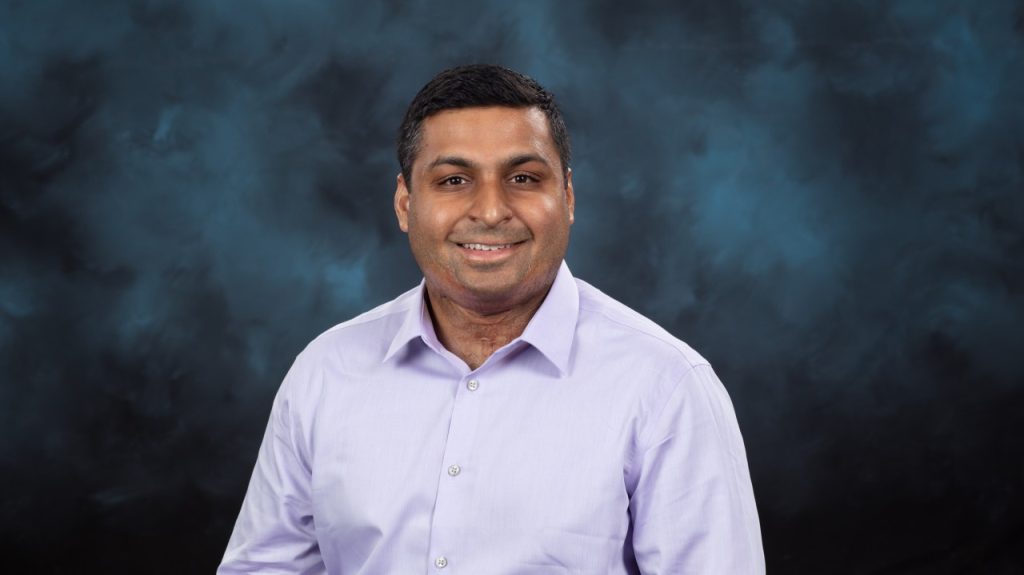
When Dr. Rajan Kumar began working on printed electronics during his Ph.D. at the University of California San Diego, he was fascinated by the semiconductor industry’s ability to make complex technology ubiquitous. He wondered whether printing techniques similar to those used for newspapers could do the same for solar cells, batteries and other energy technologies. That question led Kumar and his collaborators to develop the first all-printed, intrinsically stretchable rechargeable battery, capable of functioning even after being repeatedly stretched to twice its original length. It also became the scientific foundation for Ateios Systems, the battery startup Kumar founded with fellow UC San Diego researcher Carlos Munoz.
Ateios initially set out to commercialize flexible batteries that could be printed directly onto clothing, wearables and other unconventional surfaces. The idea grew from ARPA-E-supported research into batteries that could be integrated into garments without adding a rigid or noticeable power source. But while trying to manufacture those batteries, Kumar encountered a much larger problem. Traditional electrodes are made by mixing active battery powders with polymer binders and solvents, coating the resulting material onto a substrate and running it through large drying ovens. The heat required during this process made it difficult to print batteries on paper, textiles and other sensitive materials. More importantly, Kumar realized the same slow and expensive manufacturing process constrained nearly every lithium-ion battery, regardless of its ultimate application.
“The problem is more manufacturing than performance,” Kumar said. “Whoever can solve this manufacturing process would not only enable all these unique applications for batteries, but also game-change the entire battery manufacturing process.” Instead of remaining focused on the relatively small stretchable-battery market, Kumar pivoted Ateios toward a platform that could improve how conventional electrodes are produced. The company licensed electron-curing technology developed at Oak Ridge National Laboratory and began building its own portfolio of materials, processes and manufacturing expertise around it. The result became RaiCure, Ateios’ solvent-free electrode-manufacturing platform, and RaiCore, its line of production-ready electrodes.
Kumar describes RaiCure as a third generation of electrode coating. The first is the conventional wet process, which offers speed and consistency but depends on chemical solvents and energy-intensive drying. The second is dry-electrode manufacturing, which eliminates solvents but introduces its own processing and scalability challenges. Ateios’ approach uses a coatable resin that is cured almost instantly using electrons at room temperature, similar to how photopolymer resins solidify layer by layer for 3D printing or as photoresists for semiconductor etching. According to the company, enables faster speed and coating quality compared with wet coating while removing the solvents, drying ovens and fluorinated binders responsible for much of the process’s cost and environmental footprint. Ateios says the platform can also support thicker electrodes and stable to high-voltages, which enables manufacturers to pack more energy into a battery without radically changing its size.
Eliminating solvents has significant implications for factory economics. Kumar says a conventional production line can require approximately 80 meters of drying ovens, with tens of millions of dollars in equipment and operating expenses dedicated to removing a chemical that provides no value once the electrode is finished. The platform uses polymers that contain no fluorine chemicals, often called forever chemicals, from its electrodes. These compounds have come under increasing regulatory scrutiny because of their persistence in the environment and potential health effects. Ateios announced in 2025 that Intertek testing found zero parts per million of targeted PFAS in its RaiCore LCO electrodes, positioning the technology as a potential alternative for manufacturers facing tighter environmental requirements without compromising performance.
Proving that the technology could work outside a laboratory required Kumar to rethink the traditional battery-startup playbook. Rather than raising tens of millions of dollars to construct a dedicated pilot plant, Ateios moved from San Diego to southern Indiana and established itself inside the Battery Innovation Center, one of the country’s few shared-use facilities dedicated to battery development and manufacturing. The move gave Ateios access to production equipment, testing infrastructure, established suppliers and experienced battery engineers for a fraction of the cost of building its own facility. Kumar compares the strategy to the fabless semiconductor model called Sematech, in which chip companies validate designs through shared facilities and manufacturing partners before committing capital to dedicated production.
That model ultimately helped Ateios take its technology to multiple manufacturing partners like Eastman Kodak. Kodak had previously supported early work between the Department of Energy and Oak Ridge, giving it familiarity with the underlying electron-curing process. Instead of asking Kodak or future customers to replace their coating infrastructure, Ateios demonstrated that RaiCure could be added to an existing production line. In September 2025, Ateios and Kodak reported electrode-coating speeds of 80 meters per minute, nearly three times the commonly cited industry benchmark of 30 meters per minute. Kumar said the demonstration increased throughput on Kodak’s line by roughly 10 to 15 times compared with the speeds its available dryers previously supported.
The Kodak collaboration also validated Ateios’ capital-efficient manufacturing strategy. Kodak’s pilot line can reportedly support more than 500 megawatt-hours of annual electrode production, while its larger infrastructure could exceed two gigawatt-hours. By combining Ateios’ materials and curing technology with Kodak’s coating expertise, the companies believe they can move certain electrode designs from laboratory development to commercial-scale production in two to three months. Ateios has since announced purchase orders and shipments to battery manufacturers in Asia and North America, as well as a collaboration with Vianode to pair its cathodes with lower-emission synthetic-graphite anodes.
The opportunity extends well beyond electric vehicles. As AI chips become more powerful, the devices containing them need more energy and higher power output. That is especially important for laptops, drones, robotics and defense systems that cannot remain connected to the electrical grid. “People are spending billions of dollars optimizing their chips for their AI algorithms for any edge,” Kumar said. “That level of optimization and design cannot be ignored at the battery?” In his view, chips may serve as the brains of modern machines, but batteries are the heart that determines how long and where those machines can operate.
Ateios has now raised at least $8.5 million in publicly announced venture financing, secured a $2.4 million Department of Defense contract and closed a $7.25 million Series A led by TitletownTech. It was also named 2025 Battery Manufacturer of the Year at The Battery Show North America. Yet Kumar’s larger ambition is not simply to build another battery company. He wants to establish a new manufacturing standard that allows existing factories to produce more batteries with less capital, energy and waste.
For Kumar, that mission began with a futuristic battery that could stretch and become as ubiquitous as a piece of clothing. Its greatest impact, however, may come from the less visible discovery behind it: the realization that the world does not only need better battery chemistry. It needs a fundamentally better way to manufacture batteries at the scale the next generation of technology will demand.
