



Retailers have spent decades making product returns faster and more convenient. They have introduced prepaid labels, automated refunds, drop-off networks, and increasingly sophisticated reverse-logistics systems. Yet these tools largely address what happens after a customer decides to return a product. Rick Cramer, CEO of Returnalyze, believes the industry has neglected a much larger opportunity: understanding why returns happen and preventing the next one.
“Returns have become a trillion‑dollar drag on retail, growing at a rate 3-4X faster than retail sales,” Cramer said. “Instead of accepting returns as just a cost of doing business, we’re helping retailers improve margins and customer lifetime value by proactively reducing returns.”
Cramer joined Returnalyze in 2024 after more than two decades scaling enterprise software companies. Before taking the helm, he served as Senior Vice President of Growth Products at Tricentis and held senior roles at Signiant, Centra Software, and Avid Technology. Throughout his career, he has helped build early-stage companies through acquisitions and public offerings that collectively generated more than $2 billion in market value. That experience taught him to evaluate opportunities according to three questions: How large is the market? How serious is the problem? And can a company approach it differently enough to create a new category?
Returnalyze met all three criteria. While conventional returns platforms concentrate on authorizations, labels, shipping, refunds, and inventory disposition, Returnalyze analyzes the causes behind returns. Its AI connects data across products, customers, suppliers, manufacturing facilities, ecommerce pages, fulfillment operations, and return reasons. It then identifies the underlying issue, recommends an action, tracks completion, and measures the direct financial impact.
“We actually get to the root cause as to why something might be returned and then help retailers understand what action to take to prevent that from happening in the future,” Cramer explained.
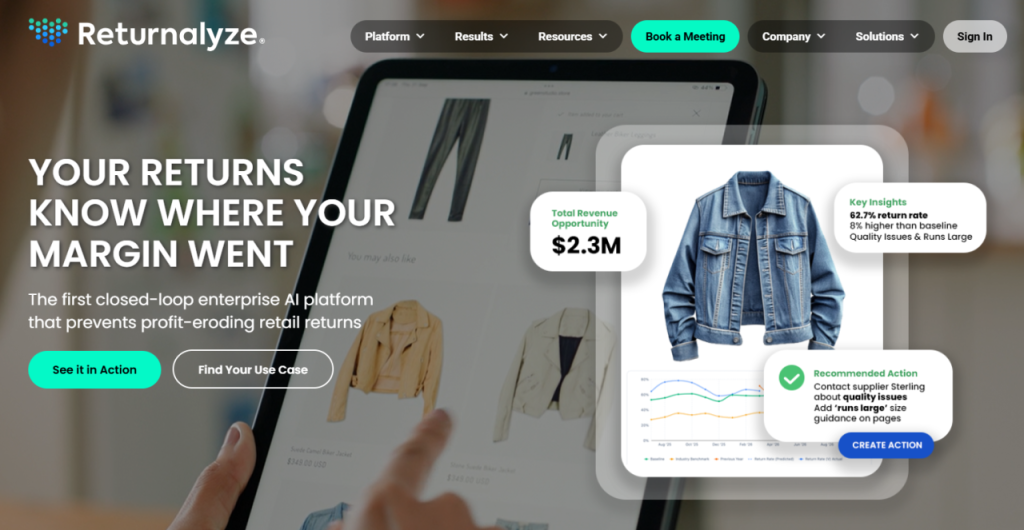
Consider a customer who loves a particular pair of jeans and orders the same style in multiple colors. Although the products appear identical, they may have been made at three different factories using slightly different materials, components, or production processes. Returnalyze could discover that one color produced at a specific factory has an unusually high return rate because of a defective zipper. Instead of treating those returns as unrelated transactions, the retailer can isolate the problem, address it with the manufacturer, redirect production, or reconsider the supplier entirely.
That level of analysis can reveal problems retailers would struggle to identify through conventional dashboards. A return may result from inaccurate sizing, inconsistent fit, a product defect, misleading imagery, incomplete product descriptions, warehouse errors, or delayed delivery. Cramer noted that for some retailers, the likelihood of a return rises dramatically when an order takes more than seven days to arrive.
The challenge is not simply collecting more information. Large retailers already possess enormous quantities of data, but that information is often distributed across departments and systems. Returnalyze synthesizes those signals and translates them into actions for merchandising, product development, manufacturing, supply chain, ecommerce, marketing, finance, and customer-experience teams.
This cross-functional approach is what Returnalyze means by a “closed-loop” system. The platform identifies why an item is being returned, prescribes the next action, assigns and tracks that action, and compares performance before and after the intervention. Retailers can then determine whether a revised product page, supplier correction, sizing update, or fulfillment change actually reduced returns and improved profitability.
The distinction matters because a product that appears successful according to gross sales may be far less valuable once its return rate is considered. High return volumes create shipping, processing, labor, markdown, and inventory costs while also damaging customer loyalty. Returnalyze wants retailers to evaluate products through returns-adjusted profitability, providing executives with a clearer picture of which products, suppliers, and customer segments genuinely create value.
This is particularly important in apparel and footwear, where returns are both frequent and highly dependent on attributes such as fit, materials, silhouette, and sizing consistency. Returnalyze’s analysis of millions of transactions during the 2025 holiday season found denim return rates exceeding 51 percent during the early shopping period, while dresses reached 48.2 percent. The company also found that retailers using active returns-prevention strategies experienced only a 0.1 percentage-point increase in overall return rates year over year, even as the broader industry continued confronting mounting returns costs.
Returnalyze now works with more than 40 major brands, including J.Crew, Abercrombie & Fitch, The North Face, Brooks Running, and Perry Ellis. The company reports that customers have reduced return rates by 20 percent or more, recovering millions of dollars in revenue while improving customer satisfaction. Cramer believes the market is beginning to recognize that returns are not an unavoidable consequence of ecommerce, but a business problem that can be systematically reduced.
The company is also expanding beyond product-level analysis. A recently launched customer module helps retailers understand buyer cohorts, purchasing preferences, and behavioral patterns. Those insights can inform marketing, personalization, and customer retention, allowing retailers to improve customer lifetime value in addition to reducing return costs.
In September 2025, Returnalyze raised a $6 million Series A1 led by FINTOP Capital, with participation from Blu Ventures, Osage Venture Partners, and Data Point Capital. Cramer said the company is using the investment to continue developing the platform and expanding its go-to-market capabilities. Returnalyze is also exploring new integrations and partnerships across the retail technology ecosystem.
Cramer sees an additional opportunity emerging as AI agents begin influencing how consumers discover and purchase products. If an agent can accurately understand a shopper’s preferences, sizing history, buying behavior, and past returns, it may help customers select products they are more likely to keep. Returnalyze is developing capabilities that will make its data and intelligence easier to access through AI platforms and other enterprise systems.
The company enters this next phase with more than six years of retail learning, proprietary analytical models, anonymized benchmarking data, and codified domain expertise. Its SOC 2-compliant platform protects individual customer information while allowing retailers to compare their performance against broader market patterns.
“We’ve got a lot of really powerful intelligence in our platform and contextual learning,” Cramer said. “There are insights that we’re able to get out of the platform that you just could never get otherwise. That’s the story.”
Returnalyze is building an intelligence layer that can influence nearly every major function inside a retailer. If successful, the company could shift returns from a reactive operational expense into a continuous feedback system for improving products, strengthening customer relationships, and driving profitable growth.
The best return, in that vision, is not the one processed most efficiently. It is the one that never needs to happen.
