


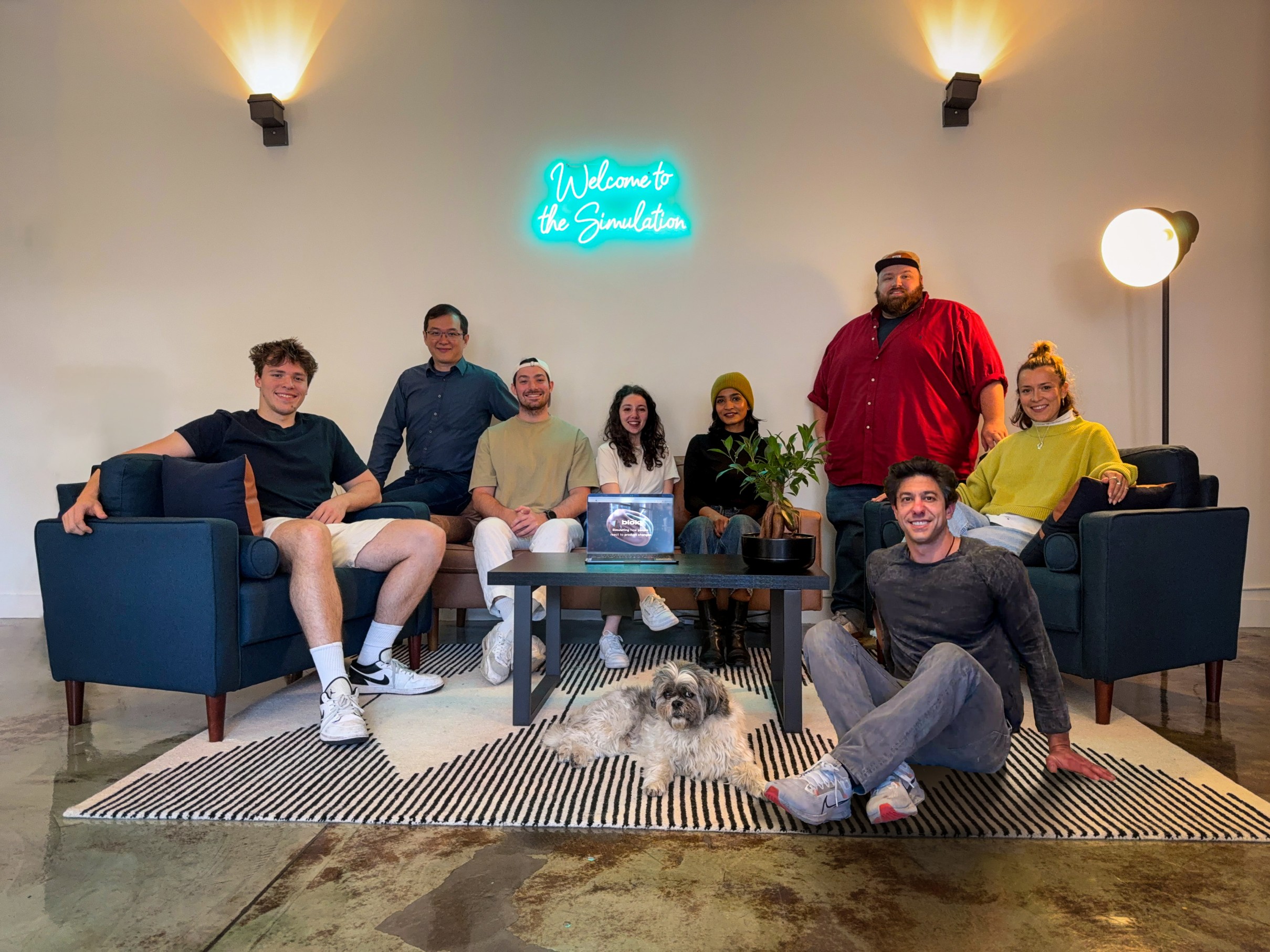
When Tom Charman moved his startup from London to San Francisco in early 2024, it wasn’t just for the weather. He and co-founder Olivia Higgs had something different in mind: a radical shift in how digital products are built, tested, and optimized, without ever touching production code. Their company, Blok, is an AI-powered product experimentation platform that helps teams simulate how different user type
In an era of software over-stuffed with features and slow A/B testing cycles, Blok offers a path toward precision before launch. At its core, it’s not just another analytics tool; it’s a behavioral simulation engine that allows product and design teams to experiment, iterate, and understand why users behave the way they do.
From Predicting Radicalization to Product Behavior
Charman’s route to predictive UX wasn’t linear. A data scientist by trade, he started his first B2B SaaS company over a decade ago, which ultimately exited. Later ventures with Higgs explored consumer discovery and behavioral prediction, some of which were shelved during COVID, but not before generating intellectual property around geospatial behavior prediction.
Between startups, Charman was contracted by the UK government to work on radicalization modeling and the prevention of terrorist attacks, applying behavioral data to high-stakes, real-world scenarios.
That same desire to understand why people do what they do forms the backbone of Blok.
“We’re combining psychographic modeling, emotional profiles, and actual product usage history to simulate how different types of users will behave,” Charman explains.

What Is a Persona Agent?
At the heart of Blok’s platform are persona agents. AI-driven behavioral avatars trained on historical product data and cognitive traits. Unlike traditional personas or marketing segments, these agents can interact with product flows and make decisions based on individual psychological attributes. They simulate not just actions, but intentions and frustrations.
“Humans struggle with complex behavior patterns at scale,” Charman says. “Our models do that for you, surfacing friction points before you’ve committed a single engineering sprint.”
Blok’s simulations use Figma prototypes, live web links and event logs (Amplitude, etc.) as inputs. The system runs several distinct agents, each with its own behavioral profile, through the mockup or live site, to test task completion, drop-off points, and emotional response. Then, it surfaces recommendations with inferred reasons behind user actions.
How It Works: The Blok Workflow
-
Design: Product teams upload a a link to their Figma prototype, website or dev environment.
-
Define: Hypotheses, goals, and target personas are selected.
-
Simulate: Agents with distinct personalities execute tasks user flows.
-
Analyze: The system returns performance breakdowns, behavioral explanations, and personalized improvement recommendations.
-
Interrogate: A chat interface lets teams ask the agents why they dropped off, succeeded, or became confused.
Experiments take 2–3 hours total, with 20–30 minutes per agent persona.
Accuracy, Speed—and Compliance
Blok isn’t just fast. It’s surprisingly accurate. In internal comparisons with traditional A/B testing, Blok’s simulations achieve significant alignment with live results. And while most experiments today require design, engineering, QA, deployment, and analysis—a cycle Charman says can stretch to six to eight weeks, especially in regulated industries—Blok collapses that down to a few hours and removes engineering from the early equation entirely.
That speed-to-insight is especially valuable in sectors like consumer finance and healthcare, where compliance restrictions prevent teams from freely deploying experimental flows.
“You can afford to run bad experiments, you just can’t afford to run them in production,” says Charman. “We give teams the ability to fail safely.”
Team, Business Model, and What’s Next
While Blok today focuses on simulation and experimentation, the long-term vision is more ambitious: adaptive interfaces personalized to individual behavior. “We want to be the behavioral layer that helps teams know exactly what to build—and for whom,” says Charman.
Blok’s team includes machine learning PhDs from Harvard, Berkeley, and researchers from the influential Voyager reinforcement learning paper. The company also collaborates with an exited unicorn founder on core research. Its customers are heads of Product, CPOs, and Heads of Data Science, and while most early adopters are in product design or engineering, the company sees future potential in security use cases, including proactive vulnerability detection during product iteration.
Blok is building more than a product testing tool. It’s crafting an engine of predictive UX intelligence, driven by behavioral insight and AI-powered empathy.
