


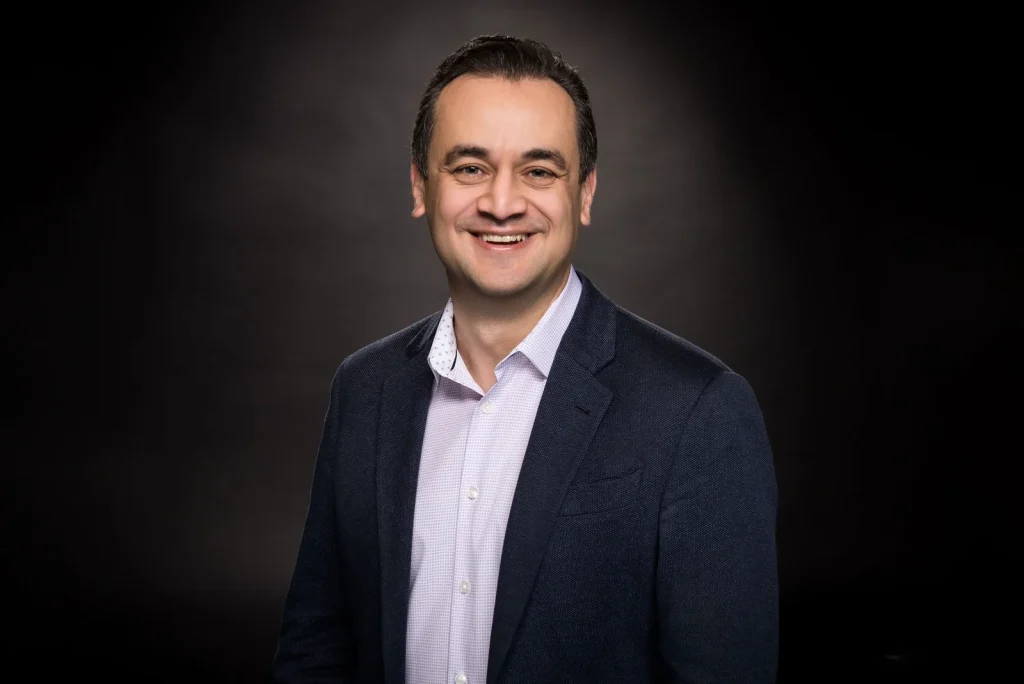
When I sat down with Hamed Amini, co-founder and CEO of Hepta, the very first thing we joked about was whether we should conduct the interview in Farsi. “Definitely not,” he laughed. What followed was a remarkably candid conversation about the limits of oncology-focused liquid biopsy, the new frontier of chronic disease diagnostics, and why decoding subtle epigenetic signals requires rethinking AI from the ground up.
Hepta is focused on one of medicine’s most pervasive, least solved problems: MASH/MASLD, a progressive liver disease affecting tens of millions yet diagnosed in less than one percent of patients. Their belief is ambitious but clear, that epigenetic patterns in cell-free DNA can reveal deep tissue biology from a simple blood draw. What sets them apart is the engineering. Instead of adapting oncology methods, Hepta built a liquid-biopsy-native AI platform designed specifically to detect the faint and nuanced signals that chronic disease leaves behind. This is the story of the founder behind that vision, and the architecture enabling it.
From Mechanical Engineering to the Frontier of Genomics
Amini didn’t enter genomics the conventional way. He began in mechanical engineering, shifted into bioengineering in graduate school, and eventually landed in Illumina’s R&D department in 2012. There, he developed core technologies across next-generation sequencing instruments and applications.
Four years later, he joined a small group leaving Illumina to found GRAIL. At GRAIL, he played a central role in building the company’s first multi-cancer early detection test. “I ran the very first methylation study at GRAIL, which became CCGA1,” he told me. “Over the course of time, I worked on everything from assay development to bioinformatics and data science.”
By the time he left in 2022, Amini had spent six years navigating every layer of liquid biopsy. But stepping back gave him space to see a much bigger frontier. He realized that while oncology had captured the headlines, its underlying models weren’t built for the far larger and more complex world of chronic disease.
Why Epigenetics Holds the Real Signal
When he and his co-founder began exploring new applications for liquid biopsy, they returned repeatedly to the same insight: chronic disease demands a fundamentally different signal.
“In chronic disease, the fragments are there. You actually have more of them. But the signal is subtle, not sharply distinct like tumor DNA,” he said.
He used one of the best analogies I’ve heard in this field.
“Oncology is like finding a pinch of black pepper in a bucket of salt. Chronic disease is like finding a spoonful of white sugar in that same bucket.” More signal, less contrast. More information, less separability.
Epigenetics, specifically methylation, offered the needed resolution. But the challenge wasn’t biological. It was computational.
Inside “Liquid-Biopsy Native AI”
Despite the hype around AI, Amini is unusually careful with the word. He emphasized that genomics data is sparse, unordered, massive, and fundamentally incompatible with language-model architectures. “You can’t just shove genomic data into an LLM and expect it to work,” he said with a smile.
To unlock chronic disease detection, Hepta built a model architecture from scratch, capable of analyzing billions of molecular interactions within a single sample, maintaining genome-wide context instead of fragmenting the data into isolated shards.
Most liquid biopsy approaches break the genome into tiny pieces for efficiency. That works in oncology where the signal is bright, but it collapses in chronic disease, where the meaningful biological pattern lies in subtle genome-wide interactions.
“In chronic disease, the interaction terms are the story,” Amini explained. “If you shard the genome, you lose the meaning.”
This architectural choice, maintaining global context, is one of the clearest competitive differentiators in the market today.
The MASH Atlas: Proving the Biology
One of Hepta’s most important breakthroughs came through a collaboration with Duke University. Together, they created the MASH Atlas, a dataset linking epigenetic signals in blood with liver tissue methylation and gene expression from the same patients.
This dataset validates something profound: the biology inside the bloodstream mirrors the biology of the liver itself. But only if you have the machinery to detect it.
“The signal gets fainter as it travels from liver tissue into the bloodstream,” Amini said. “That’s exactly where our AI machinery shines.”
By aligning tissue-level biology with circulating epigenetic patterns, Hepta demonstrated biological plausibility at a depth few chronic disease platforms have achieved. It is not only a scientific milestone but also an intellectual property moat.
What a New Diagnostic Pathway Could Look Like
I asked Amini what he believed liver disease diagnostics could become if Hepta succeeds. He answered without hesitation: “A one-stop blood test.”
In his vision, liver disease screening becomes as routine as ordering a comprehensive metabolic panel. A physician orders the test. A lab processes the sample. Hepta generates a report indicating whether the patient has disease, which therapy they’re most likely to respond to, and how they’re progressing over time.
This future becomes even more relevant as the therapeutic landscape grows. Two drugs exist today. Three or four more mechanisms of action are approaching the market. The biggest question is not whether a drug exists, but which drug is right for each patient.
“Figuring out which patient should take which drug is going to be a major open question,” he explained. “If we can help physicians make that choice with biological clarity, that changes everything.”
The Real Bottleneck: Not AI, but Data
Training Hepta’s models is computationally heavy, but deployment is easy. The real-world challenge is cost, sequencing depth, and access to high-quality clinical samples.
“Everyone gets excited about AI capabilities,” he said. “But the real constraint is the data — the quality of the samples, the depth of sequencing, the biological relevance. Generating that level of data takes time. It’s expensive. And getting the right clinical material is difficult.”
The market often assumes AI is the magic. Amini argues that data is the real moat.
A Founder with a Long View of Liquid Biopsy
Toward the end of the conversation, we drifted into Persian jokes, Boston accents, and the dangers of moving to Los Angeles and “buying $18 water at Erewhon.” It was a reminder that brilliant founders are still human, still funny, still culturally textured.
But behind the humor is a founder who has shaped the liquid biopsy field for over a decade, from inside Illumina, inside GRAIL, and now from the frontier of chronic disease with Hepta.
He sees a future where liquid biopsy doesn’t stop at cancer, but stretches across liver, cardiovascular, metabolic, kidney, and even neurodegenerative disease.
“When the signal gets fainter,” he told me, “that’s where the right machinery wins.”
And if Hepta’s vision comes to fruition, the world may soon diagnose chronic disease not with invasive biopsies or inaccessible imaging, but with a simple blood draw powered by the right AI, trained on the right biology, built by the right founder.
