
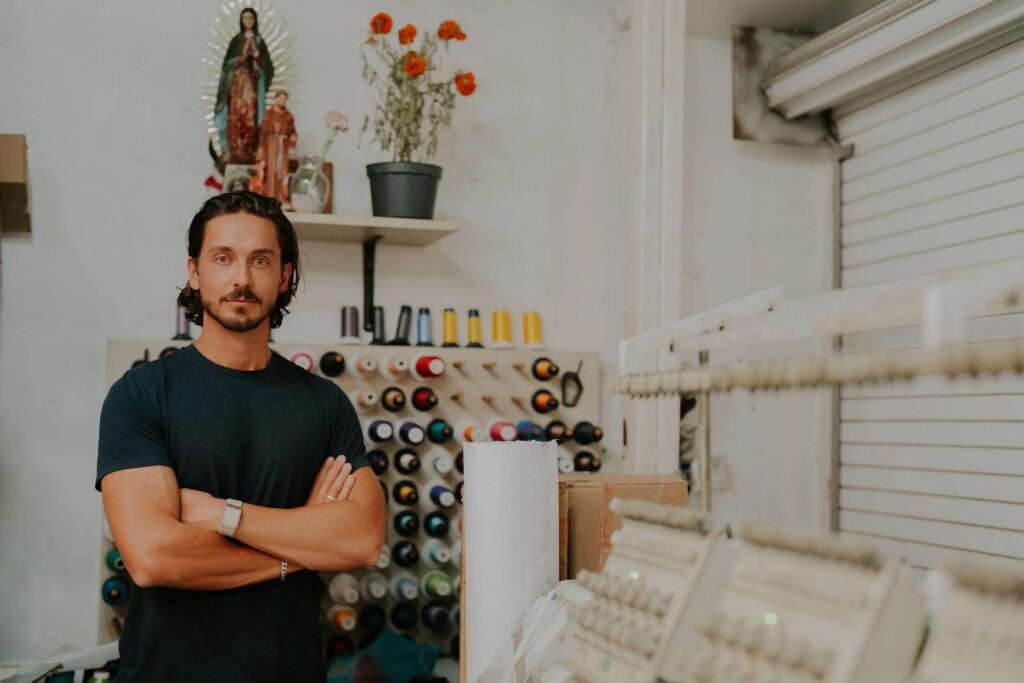
When Anthony Sardain talks about global manufacturing, he speaks with the kind of fluency that only comes from living inside the system. Raised across Malaysia, Hong Kong, Thailand, Singapore, China, and now Mexico, Sardain grew up in a family that spent three generations in international trade. “Growing up in different hubs gives you an appreciation for how different cultures work,” he told me. “One of the biggest challenges in manufacturing is getting all these pieces to work together.”
Cavela, the company he founded in 2023, is Sardain’s attempt to bridge those pieces with AI. And while today’s headlines frame “AI for supply chain” as a new phenomenon, the roots of Cavela began long before. During graduate school at McGill, Sardain built machine-learning models for global trade data, a field that, surprisingly, had evaded automation for decades. Years later, as he sourced products for family and friends, he kept running into the same painful constraints: unclear product descriptions, inconsistent suppliers, endless back-and-forth messaging, and price quotes that varied as much as 30–50 percent for identical goods.
The spark came during a single week when he found himself sourcing luxury hotel products from Thailand for a family member while simultaneously helping a friend source supplements from India. He used ChatGPT to automate some of the communication and supplier coordination, and realized the same workflow worked across completely different countries and verticals. “That became version zero of Cavela,” he said.
Why Sourcing Is Still Broken
To understand why Cavela matters, it helps to understand how founders still source products today. Most begin with Google searches or aggregator platforms like Alibaba or DHgate, platforms that are often crowded with middlemen, reused photos, or suppliers who may not actually make the product they’re advertising.
From there, brands send dozens of messages, switch between email, WhatsApp, and WeChat, and repeat the same clarifying answers over and over. Even simple products can require 500 to 1,000 messages just to secure quotes, order samples, or align on specifications. Quality control and logistics adds another layer of uncertainty.
“It’s a far cry from the automation of the rest of e-commerce,” Sardain said. “Selling is automated. Payments are automated. Freight forwarding is easier. But sourcing looks almost exactly like it did ten years ago.”
And inefficiency is rampant. Brands typically collect only a few quotes when they may need ten. Variations in pricing are massive not because of quality, Sardain argues, but because the market itself is structurally inefficient.
What Cavela Actually Does
Cavela replaces the painful manual sprint with an AI-driven sourcing assistant. Brands upload photos, sketches, or partial descriptions. Cavela’s agent asks targeted questions, fills in missing details, and translates that into a complete spec package. It then finds the best-fit suppliers among Cavela’s network of 200,000 factories across 40+ countries, handles the back-and-forth messaging, collects quotes, and manages samples and production workflows.
“Think of it as answering supplier questions once,” he explained. “The agent handles the rest.”
Cavela’s advantage is not just automation; it’s accuracy. Sardain emphasizes that product-to-country matching is critical. Apparel can be reliably produced across India, Vietnam, Mexico, Portugal, or Turkey, but electronics and molding are still best suited for China. Many brands misunderstand this. “People think sourcing is just about the factory,” he said. “But infrastructure, QA, and logistics matter just as much.”
The Geopolitics Behind Cavela’s Rise
Cavela’s timing intersects with a meaningful geopolitical shift. Tariffs and U.S.–China trade tensions have pushed brands to rethink where and how they produce goods. Sardain is quick to point out that this isn’t just about moving manufacturing out of China, sometimes that introduces more problems. Instead, Cavela helps brands identify whether diversification makes sense and when it’s more efficient to stay in China but broaden supplier discovery.
“For a moment in time, every brand had the exact same pain point,” he said. “And it happened to be the one we were positioned to solve.”
Scaling the Future of Sourcing
Cavela recently raised a $6.6 million seed round, bringing its total funding to over $8 million. The company now supports hundreds of products across dozens of verticals, and its platform continues to improve as more suppliers and workflows flow through the system.
The goal isn’t to replace humans, it’s to eliminate unnecessary waste, widen supplier access, and give early-stage brands the kind of sourcing power usually reserved for large enterprises.
“We’re helping brands spin up quick and efficient supply chains with reliable suppliers and lower production costs,” Sardain said. “That’s the core of it.”
If Cavela succeeds at scale, sourcing a product may one day be as simple as describing it to an AI. And for brands navigating tariffs, shifting manufacturing landscapes, and global complexity, that future can’t come soon enough.