

When Koen Mulders left a 20-year career building billion-euro product lines at Philips and Versuni, it wasn’t to slow down. It was to focus on the one challenge he’d always wanted to tackle head-on: making sustainability a business driver, not just a corporate checkbox.
“I always liked to build new categories,” Mulders says. “But within a large company, sustainability was never the core of the business. I wanted to be an entrepreneur in impact, creating something unique, relevant, and differentiating, with real positive effect.”
That opportunity arrived when he met Rick Goud, a serial founder with a background in cybersecurity, and Mark van den Brink, a veteran in electronics and software. The two had been tinkering with a solution to a growing problem in the Netherlands: sky-high energy costs, grid congestion, and no simple way for homeowners or SMEs to manage it all. Together, they founded Currentt.
A Perfect Storm in Dutch Energy
The Netherlands is a global leader in solar adoption, ranking number one in solar panels per capita. It’s also among the top two countries ranked first facing severe grid congestion. Infrastructure built in the 1960s is buckling under the combined load of electrification, wind, and solar generation. The result is over 12,000 Dutch businesses are stuck on waitlists for new grid connections, stalling growth and decarbonization plans. In addition, grid congestion is preventing entrepreneurs from expanding or implementing their sustainability plans. Boston Consulting Group has calculated that the Netherlands is losing 10 to 35 billion euros in economic benefits every year as a result of this problem.
Compounding the challenge is the looming end of the salderingsregeling (net metering) in January 2027. Today, a solar owner who generates 3,000 kWh and consumes 5,000 kWh annually only pays for the 2,000 kWh net difference. When that arrangement ends, the incentive to self-consume solar energy spikes, and the penalties for notmanaging it well could be steep.
“Most solar owners today only use on average 30% of what they generate,” Mulders explains. “Seventy percent is sent back to the grid, and even more in summer, when it’s already overloaded. After 2026, that 70% will no longer be financially offset. You’ll want to use every kilowatt-hour you produce.”

Enter the Currentt Navigator
At the heart of Currentt’s offering is the Navigator, a compact local energy management system that installs in a building’s fuse box. From there, it measures, controls, and optimizes energy flows between generation sources (solar, batteries), consumption points (heat pumps, EV chargers, production equipment), and the grid itself.
Three core principles define its design:
-
Local-first control – The Navigator runs independently of the cloud, ensuring it keeps working even during internet outages. Commands flow outward from inside the building, reducing cyber risk and boosting reliability.
-
Brand agnostic – It works with any make of charger, heat pump, or battery. This flexibility prevents lock-in and simplifies life for installers.
-
Installer simplicity – Developed with feedback from installers, the system minimizes setup complexity, enabling tradespeople to focus on what they know best without learning proprietary software ecosystems. Known for its unmatched installation simplicity, Currentt makes EMS accessible for every installer. With automatic device detection and a smart setup wizard, even those with little software knowledge can install and activate a fully integrated system in no time.
The Navigator can “shift load” for businesses that can’t get a larger grid connection, spreading consumption intelligently over time. For residential and SME users, it prioritizes using self-generated solar in real time, charging batteries, running appliances, or scheduling EV charging when excess is available, reducing the energy costs.
From Award-Winning Innovation to Market Rollout
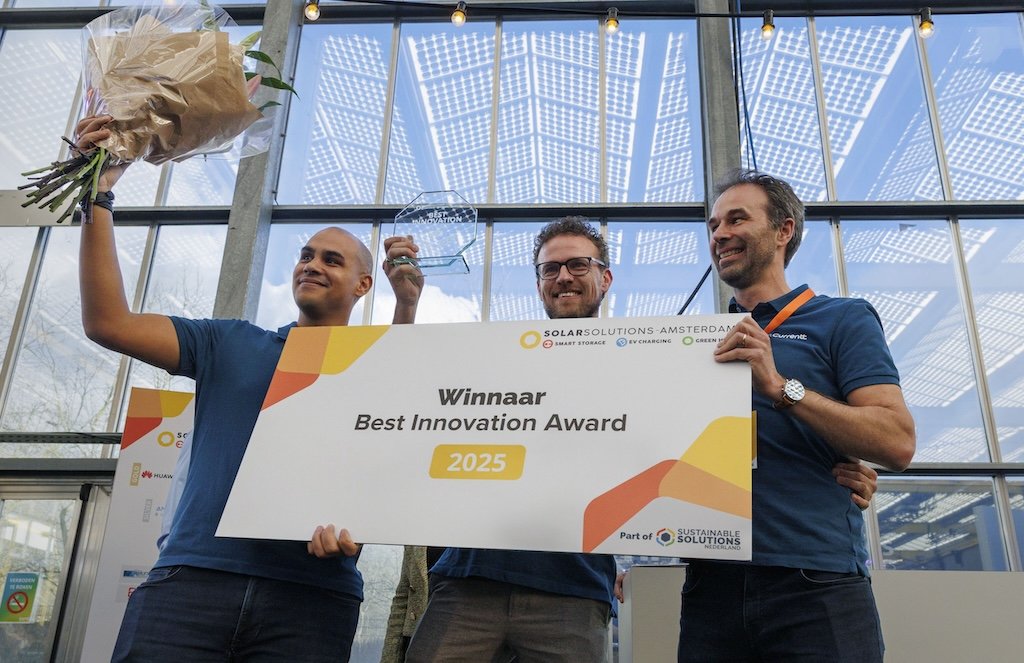
In 2025, Currentt’s Navigator won the Best Innovation Award, beating out over 300 multinational and startup competitors. Judges cited its ability to solve a “blocking point” in the energy transition: turning complexity into actionable, user-focused control.
Currentt is now in pilot stage, with a full market rollout planned for Q4 2025. The initial focus is on Dutch installers and SME clients, before expanding into Belgium and Germany, markets facing similar congestion and regulatory shifts.
With backgrounds in industrial design, consumer electronics, software, and cybersecurity, Currentt’s founding team is betting that the path to a sustainable grid isn’t just about more generation, it’s about better orchestration.
By keeping control local, brand-agnostic, and installer-friendly, the Navigator sidesteps some of the biggest adoption barriers in energy tech. And in a country racing against both regulatory deadlines and physical grid limits, that might be exactly what’s needed.