

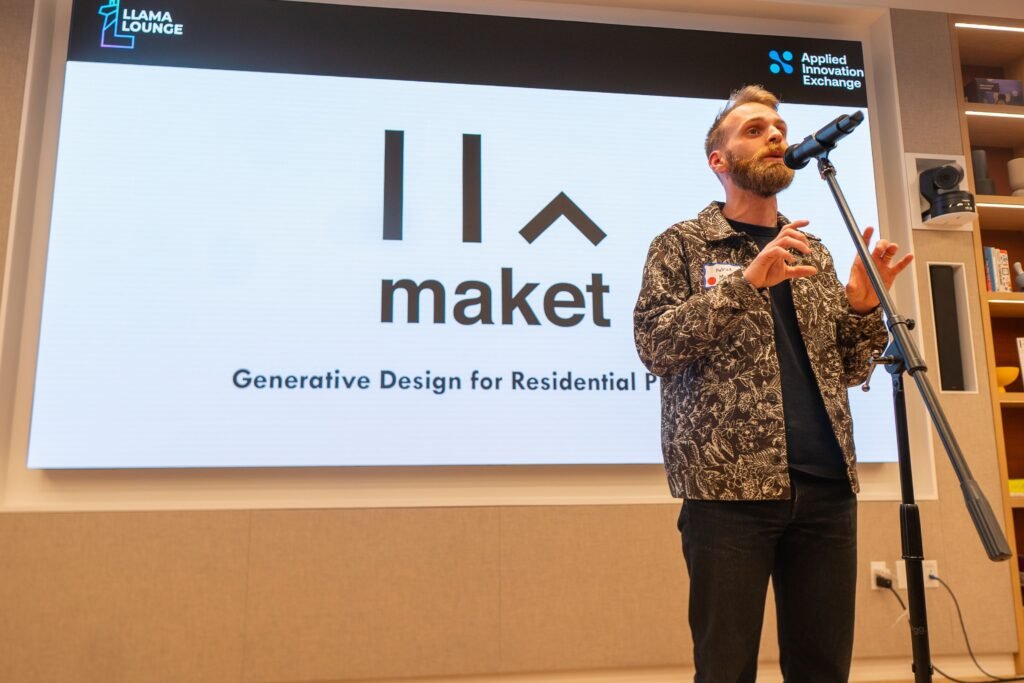
When Patrick Murphy describes Maket, he talks about democratization and a mission to make the architectural process as accessible as designing a social media post in Canva.
“We founded Maket on the same principle that Canva did,” Murphy says. “They made graphic design accessible through web-based editing. We’re doing the same for architecture using generative AI.”
Maket’s ambition sits squarely at the intersection of two massive challenges: the global housing shortage and the technical inaccessibility of architectural design. Its software allows anyone, from homeowners to builders, to generate and edit full residential floor plans using simple text prompts. The result is a creative tool that’s simultaneously human and computational, blending spatial intelligence with a user interface that feels more like ChatGPT than AutoCAD.
From Research to Reality
Founded in 2019 in Montréal by Murphy, COO Stéphane Turbide, and CPO Simon Vallée, Maket grew out of a conviction that architectural tools hadn’t evolved fast enough for a world demanding more homes, faster. Turbide, an architectural technologist, had spent a decade inside the profession and saw firsthand the inefficiency of existing software like Revit and Rhino. Murphy brought a background in go-to-market strategy and design, while Vallée, a three-time founder with exits to Groupon, Slack, and Figma, added deep product leadership and a personal motivation after renovating his own house.
Before generative AI went mainstream, Maket was already experimenting with it. In 2022, Maket collaborated with Mila, Montréal’s world-renowned AI research institute, to create a proprietary floor-plan generation algorithm. That early R&D work became the foundation for Maket’s first product launch in 2023, which quietly exploded to over one million registered users.
“Most of our growth was organic,” Murphy explains. “We started out building for architects, but homeowners, developers, and homebuilders all came to the platform saying, ‘I just want to generate plans quickly and see what’s possible.’”
The Agentic Leap: Maket 2.0
The upcoming Maket 2.0 release, scheduled for early 2026, represents what Murphy calls the shift from “SaaS 2.0 to Agentic Platforms 3.0.”
The new platform operates more like an architectural assistant than a traditional design app. Users type (or soon, speak) a prompt describing their needs, “a two-story modern home with four bedrooms, optimized for energy efficiency”, and the AI instantly generates compliant floor plans, layout options, and 3D visualizations.
“It’s ChatGPT for architecture,” Murphy says plainly. “You can generate, edit, and visualize plans in seconds. And soon we’ll integrate zoning code verification, HVAC planning, and material takeoffs, the full design-to-construction chain.”
The leap isn’t trivial. Unlike text or image generation, architectural AI must obey strict spatial, structural, and regulatory logic. Murphy’s team had to build their models from the ground up rather than fine-tuning off-the-shelf architectures.
“It’s not as simple as throwing a wrapper on top of a foundation model,” he says. “You can’t have a garage showing up in the middle of a living room. The orchestration between AI agents, plan generation, recognition, and optimization, took years of R&D.”
A Global Vision Rooted in Montreal
Maket’s $3.4 million CAD seed round, announced in October 2025, was led by Amiral Ventures with participation from Blitzscaling Ventures, Hidden Layers, BY Venture Partners, and Spatial Capital. The company has now raised over $4 million CAD to date and grown to a 14-person team.
Montreal isn’t just Maket’s headquarters, it’s part of its strategy. The city is one of the world’s densest AI talent hubs, anchored by Mila and a strong academic ecosystem. “We made a deliberate decision to take Quebec-based capital,” Murphy says. “We believe in building here, but we also wanted strategic investors who could help us expand globally.”
BY Venture Partners, for example, brings connections across the UAE market, where rapid development and regulatory modernization make architecture ripe for AI-driven solutions.
Architecture, Reimagined, Not Replaced
Murphy is quick to address the existential question surrounding automation. When asked whether AI will make architects obsolete, he doesn’t hesitate.
“Canva exists, and graphic designers still exist,” he says. “Creativity is still the essence. Architects will focus on higher-value projects where their creative and spatial judgment really matter.”
He envisions a near future where AI handles the 80% of design work that’s repetitive or constrained by codes and dimensions, while architects evolve into creative consultants, focusing on originality, sustainability, and the human side of design.
“There’s a shortage of architects globally,” Murphy notes. “We simply can’t produce housing fast enough. AI won’t replace them, it’ll amplify them.”
Beyond Housing: Toward an Agentic Design Ecosystem
Though Maket’s core focus is residential, demand is already spilling over into commercial projects, from hotels to retail spaces, with over 95,000users on the waitlist for those capabilities. For now, the company is staying disciplined. “We’re staying focused on housing,” Murphy says. “We need to build more of it, and we need better tools to make that possible.”
Still, the company’s ambition is unmistakable. In the long term, Murphy wants Maket to evolve into a true end-to-end architectural OS, a system capable of managing every step from initial layout to fabrication. The team is already exploring partnerships with in Japan to integrate their own historical floor plans directly into Maket’s model training.
Underneath the product demos and agentic workflows, Maket is really an argument about accessibility, that creativity and spatial intelligence shouldn’t be confined to a small professional class.
Murphy puts it simply:
“We want to get people 99.9% of the way there. An architect still has to sign off, but anyone should be able to create a vision for their home.”
As Maket prepares to launch its 2.0 platform, that vision feels less like science fiction and more like inevitability. Architecture, one of the oldest human arts, is being rebuilt, not by replacing human imagination, but by expanding who gets to use it.