

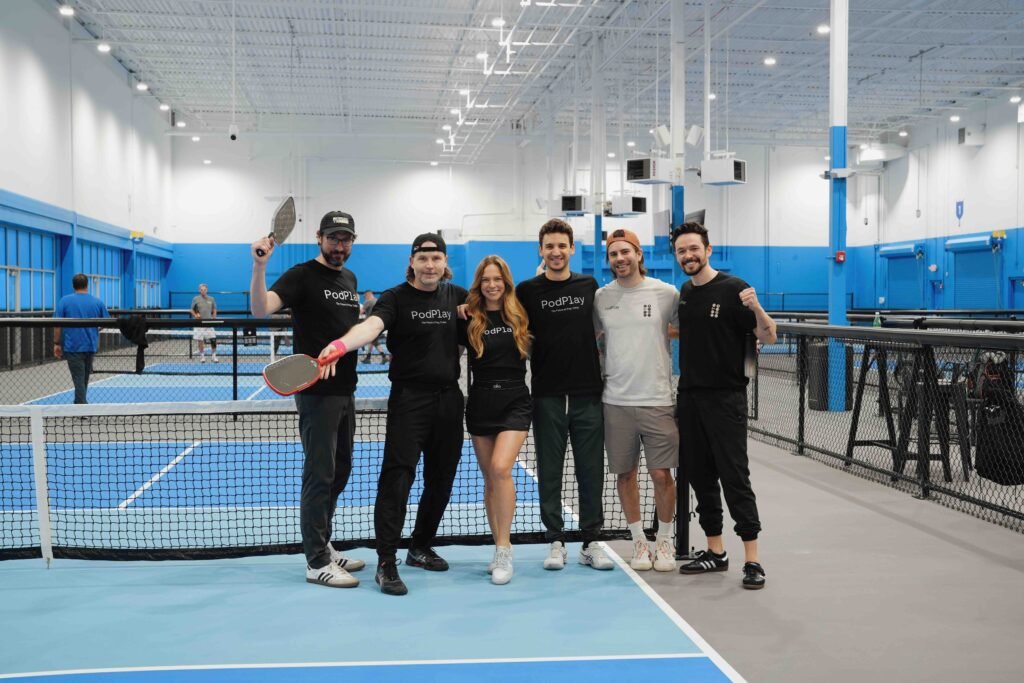
When Ben Borton talks about fun, he’s not being cute. He means it as a business principle that’s measurable, repeatable, and scalable. “Our mission is to increase the amount of fun being had in the world,” he says with a smile. “It’s hard to poke a hole in that.”
Borton is the co-founder of PodPlay Technologies, a New York-based startup that has quietly become the operating system for a new generation of sports venues, from pickleball clubs and golf simulators to ping-pong studios and padel courts.
Their premise is deceptively simple: build technology that gets people off their phones and back into real-world play.
“Use your phone to put down your phone,” Borton says. “We’re building tech that’s in service of people and fun, not the other way around.”
From PingPod to PodPlay
The story starts with PingPod, the autonomous table-tennis network Borton helped launch in 2019 alongside CEO Max Kogler and co-founders Ernesto Ebuen and David Silberman.
The team’s question was audacious: could you run a profitable sports venue without staff, food, or alcohol, powered entirely by software and sensors? The technology didn’t exist off the shelf. So, they built it themselves.
“We had to insert technology and subtract labor,” Borton recalls. “Could you run smaller format pods that weren’t dependent on food and booze to achieve profitability?”
They launched their first location in February 2020, and, like every other non-essential business, shut it down a month later. But the pandemic proved to be a blessing in disguise. With contactless access, automated monitoring, and built-in social distancing, PingPod became one of the first businesses in New York to reopen that spring.
“We could track everyone who came through the door,” says Borton. “It actually took off during the pandemic.”
The concept worked. PingPod grew to 25 locations, raised capital from Sequoia Heritage, and proved that autonomy could unlock entirely new economics for physical recreation.
“Our goal was always to build a tech platform that could then be extended to other like-minded venues,” Borton explains. “You can think of it like the AWS model, build great infrastructure for yourself, then license it to others.”
That platform became PodPlay, spun out in 2023 and now powering over 200 venues across the U.S. and abroad. In October 2025, the company raised $8 million in Series A funding led by Frontier Growth. Revenue has tripled in the past year. Over one million users have booked games or sessions on the platform.
Three Layers of Play
Borton breaks PodPlay’s system into three layers, software, hardware, and autonomy.
1. Software
At its core, PodPlay is a mobile-first booking and membership engine built for venue operators.
Each client gets a white-labeled web and app experience under their own brand.
“There’s no PodPlay app,” says Borton. “Every club has its own. Ninety-five percent of bookings happen on phones, so we built mobile-first from day one.”
2. Hardware
Digital scoreboards and instant video replay systems that turn every match into a shareable highlight. When players hit a winning shot, they press a button, and within seconds, their clip appears on the monitor and in their app. “We’ve served over a million replays,” Borton says. “It’s this fountain of user-generated content. Players want to share the experience, but they don’t want friction.”
Clubs can even monetize those replays. Sponsors buy ad slots embedded in the clips, creating new revenue streams that, in some cases, exceed what clubs pay PodPlay each month. “We call it digital word of mouth,” he adds. “If someone’s sharing a video of themselves having fun in your club, what’s better marketing than that?”
3. Autonomy
The top tier combines software and hardware with full access control, security, and 24/7 remote monitoring, allowing venues to operate without on-site staff. Roughly a third of PodPlay’s partners run fully autonomous clubs; the rest use the platform for software or hybrid operations. The business model is usage-based: a per-court or per-bay license fee, with pricing tied to ROI.
“We’re not competing on price,” Borton says. “We’re competing on ROI.”
The Human Side of Autonomy
Automation, Borton insists, isn’t about replacing people, it’s about redirecting human energy to where it matters. “When we started, people asked, ‘Won’t you lose the human touch?’” he says. “Our view was: not necessarily. The human touch isn’t a priori a good thing.”
Many staffed venues, he notes, struggle to retain front-desk employees, the work is transient, turnover is constant, and often the person behind the counter is distracted or disengaged.
By removing that layer, operators can reinvest in community and coaching.
“It’s not like there’s nobody there,” says Borton. “They redirect effort toward organizing leagues, running clinics, and building culture. It’s a shift from cost center to community center.”
That philosophical shift has another byproduct: smaller venues suddenly make sense.
Without staff overhead, a four-court pickleball club in Manhattan or a micro golf simulator in San Diego can now run profitably.
“In dense urban areas, the ability to go small is an unlock,” Borton explains. “It’s really hard to find space for a 15-court club. But you can find space for three.”
The Founder’s Lens: From Hedge Funds to Pickleball
Before entering the recreation space, Borton spent a decade in finance. He led digital fund services at Figure Technologies and was a partner at Mountaineer Partners, a long-short equity fund. He was also the first outside investor in PingPod before joining full-time to help scale its tech and strategy.
“There are innovations that change consumer behavior, and there are innovations that change business economics,” he says. “When you get both, that’s powerful.”
That dual lens, investor discipline and founder empathy, defines how he runs PodPlay today. “It’s rare to find a business that has strong economics and is also unambiguously good,” he adds. “We’re getting people into physical spaces to do things that are fun, social, and healthy. My kids get it, that’s a good test.”
The Future of Frictionless Sports
PodPlay’s next chapter involves expanding beyond pickleball and ping-pong into golf simulators and new forms of “digital-physical recreation.” The company is actively partnering with multi-location operators, and seeing migration from legacy systems as proof of product-market fit.
“Forty percent of our locations came from venues that migrated off other systems,” Borton notes. “You have to be a lot better for someone to rip and replace. That’s happening.” Longer term, he envisions PodPlay as the connective tissue for how humans socialize through sport, a platform that makes local play as discoverable, measurable, and shareable as digital entertainment once was.
“The future of sports venues is connected, digital, and frictionless,” he says. “We’re building the infrastructure for that.”