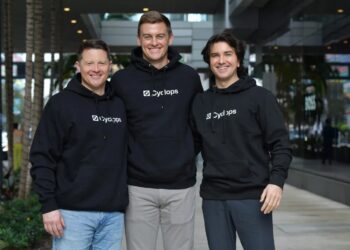


When Sebastian Samuelsson joined five other co-founders to launch LayerLogic, the goal wasn’t modest: turn advanced graphene field-effect transistor (GFET) research into a scalable, commercially viable biosensor capable of detecting pathogens in minutes rather than days.
“It started at Chalmers University of Technology,” Samuelsson recalls. “In the last year of our Master’s, business students get matched with researchers who have a novel idea. You spend that year figuring out, can we commercialize this? Is there a market? Are there customers who would pay for the solution?” For Samuelsson, the answer was an emphatic yes.
Solving the GFET Scalability Problem
Before LayerLogic’s breakthrough, manufacturing GFETs at high quality and low cost was a persistent industry bottleneck. The company’s core innovation is a production method that makes these sensors scalable while also improving performance. But Samuelsson stresses that solving one hard problem only reveals the next.
“Once you have the GFET base,” he explains, “the next challenge is functionalizing it. Adding the receptor molecules that bind to the pathogen. That attachment has to be close to identical every time, otherwise you can’t sell at the quality level biosafety demands.”
Balancing R&D Speed With Market Urgency
Unlike many deep-tech startups that vanish into years of stealth mode, LayerLogic has pushed to get its technology in front of real customers early.
“We’re very market-focused,” Samuelsson says. “We’ve already done four paid pilot projects with future customers. We try to keep them close to the process, making sure our R&D moves as fast as possible, without skipping the checks that matter when you’re talking about bacterial detection.”
Translating Value Outside the Lab
When explaining LayerLogic to a non-technical audience, Samuelsson leans on a simple analogy. “Take salmon. It has a two-week shelf life. Current tests can take five days. That’s more than a third of its marketable life gone. If we can give them an accurate result in under 15 minutes, it completely changes their operations.”
Looking Ahead
LayerLogic recently closed a €470,000 pre-seed round led by Scientifica VC. For Samuelsson, the pitch hinged on both technical and commercial clarity.
This framing isn’t just for consumers. It’s how LayerLogic communicates with regulators, industry partners, and potential pilots. And choosing the right pilots matters. “We look at the individual contact, location, the potential to be a large future customer, and whether they’re respected enough that if they trust us, others will too. Sometimes, one Norwegian-owned seafood producer can open doors to an entire market.”
LayerLogic’s trajectory, born from university research, solving a key manufacturing hurdle, and engaging customers early, positions it to reshape pathogen detection in the food industry and beyond. Samuelsson is pragmatic but optimistic: “If we keep aligning R&D with real-world demand, we’ll get there. The technology’s ready for more than one industry, the key is staying focused, and making sure every step we take is a step the market actually needs.”