

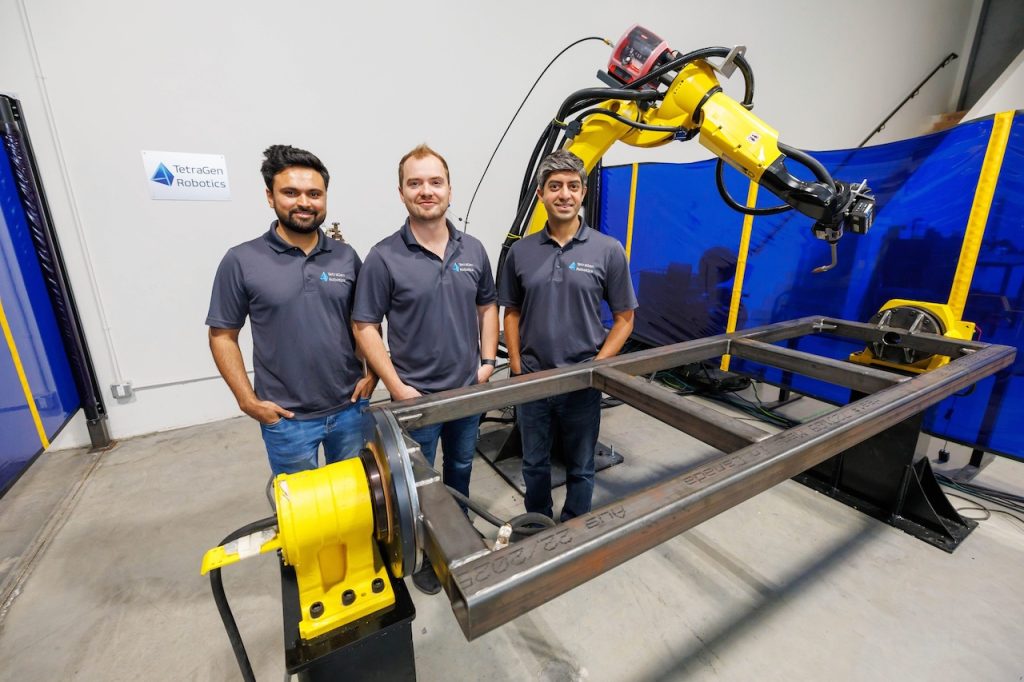
Canadian robotics startup TetraGen Robotics has raised $1.8 million CAD in an oversubscribed seed round as manufacturers increasingly turn to automation and artificial intelligence to address skilled labour shortages and rising production costs. The round was led by StepChange Capital of Calgary, with significant participation from Emend Vision Fund of Vancouver and Winnipeg-based investor Jim Richardson.
TetraGen develops autonomous welding robots for general manufacturing and describes itself as Canada’s first Physical AI company. The company has already deployed its AI-enabled, vision-guided robots in production environments in Canada.
The new funding will be used to expand TetraGen’s autonomous robotic welding systems across North America, strengthen its engineering and commercial teams, and support additional customer deployments.
Moving Beyond Traditional Robotic Welding
Traditional robotic welding can require significant programming, specialized expertise and repeatable production setups. When parts or production processes change, manufacturers may need to reprogram their robots and adjust their fixturing. TetraGen is taking a different approach.
Its autonomous welding systems combine artificial intelligence, advanced 3D vision, autonomous path planning and industrial robotics. The technology is designed to understand the physical features of a part, generate robot programs, compensate for dimensional variations and adapt to changing production conditions.
The objective is to make robotic welding easier to deploy without requiring manufacturers to extensively modify their production processes around the robot.
Rather than relying on extensive manual programming and repeatable fixturing, TetraGen’s systems are designed to allow manufacturers to deploy intelligent robotic welding cells with minimal setup time and less expertise required from the end user.
That simplicity is becoming a central part of the company’s pitch to manufacturers.
Manufacturers often expect robotic welding deployments to involve weeks of programming and ongoing troubleshooting whenever parts or processes change. During demonstrations of TetraGen’s technology, the company says one of the most common reactions is, “That’s it?”
The system is designed to reduce the complexity associated with robotic automation, allowing manufacturers to begin producing welds with less programming while reducing rework and creating more stable production operations.
Investors Bet on Autonomous Manufacturing
The new investors see autonomous welding as a potential shift in how manufacturers approach industrial automation.
“TetraGen Robotics is tackling one of manufacturing’s most significant automation challenges,” says Eric Miller, Managing Director of StepChange Capital. “Their vision for autonomous welding has the potential to fundamentally change how robotic welding is deployed across modern manufacturing environments. We heard great feedback from TetraGen’s existing customers, and that gave us the conviction to lead the company’s funding round. ”
For TetraGen CEO and Co-Founder Matt Khoshdarregi, the opportunity goes beyond making existing robotic welding systems more efficient. The company believes robots should increasingly adapt to the manufacturing environment rather than requiring manufacturers to design their operations around the limitations of robotic systems.
“For decades, manufacturers have adapted their operations to fit the limitations of robotic automation,” says Khoshdarregi. “We believe the future is the opposite. Autonomous welding systems should adapt to manufacturers, not the other way around. Our mission is to make robotic welding intelligent enough that manufacturers can focus on building great products instead of constantly re-programming and troubleshooting robots.”
Targeting North American Manufacturing
TetraGen plans to initially focus on heavy equipment manufacturing before expanding into other industries where flexibility, quality and labour resilience are becoming increasingly important. The company’s technology reflects a broader shift in industrial robotics, as advances in AI and computer vision are making it possible for machines to operate in less structured environments.
For manufacturers, the appeal is potentially broader than simply replacing manual labour. Autonomous systems that can recognize variation and adapt to changing production conditions could make robotic automation more practical for manufacturers producing different parts, smaller production runs or products that require frequent adjustments.
With its latest funding, TetraGen is now looking to expand beyond its existing Canadian deployments and scale its autonomous welding technology across North America. The company’s long-term goal is to become a leading provider of autonomous robotic welding systems for general manufacturing, with its technology serving industries where automation flexibility and labour resilience are increasingly becoming competitive advantages.
